|
PHILHARMONICA. International Music Journal
Reference:
Wang, Q. (2026). Tyzen Hsiao’s Piano concerto in C minor, op. 53 in the context of Taiwanese musical culture. PHILHARMONICA. International Music Journal, 3, 39–66. https://doi.org/10.7256/2453-613X.2026.3.80590
Tyzen Hsiao’s Piano concerto in C minor, op. 53 in the context of Taiwanese musical culture
Van Tsiyue
ORCID: 0009-0007-9469-9279
Postgraduate student; Department of Music History; Rostov State Conservatory named after S. V. Rachmaninov
17/2 Mikhail Nagibin Ave., Rostov-on-Don, Rostov region, 344038, Russia

|
1354909848@qq.com
|
|
 |
|
DOI: 10.7256/2453-613X.2026.3.80590
EDN:
EFBYVC
Received:
06/13/2026
First review received: 06/19/2026 16:48 — manuscript returned for revision
Revised manuscript submitted: 06/25/2026 20:34
Second review received: 06/30/2026 09:41 — manuscript returned for revision
Revised manuscript submitted: 07/13/2026 10:32
Final review received: 07/16/2026 20:18 — recommendation for publication.
The article is published in its final version as approved following the last positive peer review recommending acceptance for publication. It incorporates revisions made by the author in response to prior negative peer review reports that did not recommend publication. All peer review reports, including initial negative reviews, are published in open access alongside the article. All versions of the author’s revisions are archived in the publisher’s repository and may be made available upon reasonable request in accordance with Elsevier’s editorial policies and applicable data availability requirements.
Read all reviews on this article
Published:
10/02/2026
Abstract: The subject of this study is Tyzen Hsiao’s Piano Concerto in C minor, Op. 53, within the context of the genre’s development within Taiwan’s musical culture in the 20th and early 21st centuries. This research approach required a step-by-step examination of the composition’s creation and cultural context, as well as a thorough textual analysis and compositional features. The concerto represents Tyzen Hsiao’s most significant work for piano. Work on it lasted over two years and was completed by April 1992. A seminal example of Taiwanese classical music, the concerto vividly demonstrates the very essence of the composer’s creative concept, which is based on a synthesis of Chinese and Western musical cultures. The author’s comprehensive approach to studying Taiwan’s professional musical culture required the use of specialized musicological research methods: music analysis and musical textual criticism. The scientific novelty lies in a new approach to studying the interaction between Taiwanese cultural traditions and academic music forms in the piano concerto by Tyzen Hsiao. The results obtained lead to the conclusion that Tyzen Hsiao’s concerto possesses a distinctly national character and a romantic style conveying the composer’s nostalgic feelings for his homeland, which he left. The composer drew inspiration from Taiwanese folk songs, carefully treating them and organically weaving them into the fabric of the composition. The uniqueness of Tyzen Hsiao’s creative thinking is based on combining elements of Taiwanese national culture with Western European compositional techniques from various styles and movements, ranging from mature Romanticism to Modernism. Overall, the issues addressed in this article lie in the study of the significance of traditional Chinese national elements in the musical language of Tyzen Hsiao’s works, which can serve as a guideline for further work on his piano legacy.
Keywords:
Chinese musical culture, Tyzen Hsiao’s creative work, piano concerto, Taiwanese academic music, piano performance, composers of Taiwan, folk music of Taiwan, compositions by Tyzen Hsiao, interaction of cultures, style of Tyzen Hsiao
This article is automatically translated.
You can find original text of the article here.
The relevance of the research topic is determined by the significance of the piano work of Xiao Taizhan (1938-2015), one of the most representative Taiwanese composers of the 20th and early 21st centuries, for the culture of the East Asian region.
The composer was born in Taiwan during the period of Japanese colonial rule, and his career coincided with a period of acute political and socio-economic transformations in the province. During his life, the composer lived in Taiwan, Japan and the USA. The composer's fundamental academic education, rich life experience, and love for the national culture of Taiwan significantly influenced the formation of his distinctive style. Xia Taizhang received a professional musical education.
In 1956, he entered the Music Faculty of Taiwan State Normal University (National Taiwan Normal University), and then continued his studies at Tokyo Musashino Academy of Music (Musashino Academy of Music). During his brilliant career, Xiao Taizhan has been awarded numerous national awards: The Award for Achievements in the Humanities from The Taiwanese-American Foundation (The 6th Taiwanese American Cultural Exchange Foundation's Humanities Award); The Golden Bell Award for Best Composer (The 10th Golden Bell Award for Best Composer); The National Award in the field of arts (The 8th National Award for Arts); The National Cultural Award of Taiwan (The 28th Executive Yuan Cultural Award), etc.
Even during his studies at the Taiwan Pedagogical University, Professor Xu Changhui noted Xiao Taizhan's creative abilities, suggesting that he find his own individual style (cit. according to: [1, p. 81]). The professional advice of the teacher prompted the young pianist to seriously study composing techniques of various musical styles and trends and, subsequently, to form his own author's approach to creating works synthesizing elements of Taiwanese folk music with forms of academic tradition.
The composer is called "the first representative of the Taiwanese national school." The Piano Concerto in C Minor, Op. 53 represents the pinnacle of Xiao Taizhan's piano work. It remains to be regretted that to date, due to the inaccessibility of the score, this work has not received wide coverage in research papers, and existing works rarely delve into the compositional features of the Concert.
Despite a long series of studies, in one way or another, affecting the problems of stylistic characteristics and compositional features of the Concert, the degree of scientific elaboration of the topic is low. The article by Chuang Wenda [2] contains only a brief description of the work, while the works by Huang Wanshu [3] and Chang Linmin [4] focus more on performance interpretation. Along with this, Huang Wanshu casually reports on the use of elements of Taiwanese musical culture in the concert's music, and Chang Linmin compares Xiao Taizhan's composition with S. V.'s Second Piano Concerto. Rachmaninoff, revealing similarities and differences in the composer's techniques.
The monographs of Lin Hengzhe [5], Cai Mingyun [6] and Yan Huarong [1] are biographical in nature. They record the composer's life and creative path. These studies are arranged chronologically and describe both the aesthetics of the composer and the compositions created by him during certain periods of his work. Lin Hengzhe's monograph deserves special attention, in which the study of the composer's work is based on a large amount of materials (music criticism articles, statements by Xiao Taizhan and his contemporaries). Sun Shuwen [7], analyzing Xiao Taizhan's piano compositions from the point of view of compositional technique, provided the theoretical basis for this article. The author focuses on the textual analysis of Xiao Taizhan's piano compositions, the history of their creation and compositional techniques. The monograph also examines various styles that influenced the composer's work.
Among the studies devoted to the problem of the formation and history of the development of Taiwanese piano music, articles by Liu Keting [8], Liang Maochun [9], Zhao Guanhui [10], Wang Qiyue [11] and the monograph by Liu Yuxiu "The History of Music in Taiwan" [12], published in 2003, should be noted. In his work, Liu Yuxiu systematizes historical materials on Taiwanese music. The first part of his book is devoted to the musical life in the province and introduces the reader to the most important musical events that took place during the long historical period of its development. The second part traces the transformation of Taiwanese music in historical retrospect from an acoustic point of view. This work contributes to the understanding of the cultural phenomena of Taiwanese music and serves as a source for the study of the cultural and historical context and conditions of the creation of Xiao Taizhan's Concert.
The articles by Western researchers Schudson [13] and Sangren [14] devoted to the problem of cultural integration agree in recognizing the dynamic and interactive nature of this process, but their accents differ significantly. Shudson, considering the issue from a macrosociological perspective, emphasizes that culture, through such public institutions as the media and the education system, acts as an active force for the integration of national societies, thereby revealing the institutional path of cultural integration. Focusing on the Chinese context, Sangren draws attention to the practical orientation and two-way nature of cultural synthesis, showing that integration is not limited to the simple dominance of one tradition over another, but represents a constant dialogue and mutual influence. Taken together, both works allow us to conclude that the essence of cultural integration lies not in assimilation, but in a long process of dialogue and reconciliation between different cultural levels and groups. This view opens up additional perspectives for the study of integration mechanisms in a particular musical culture of Taiwan.
The works of Xiao Di [15], Hu Bin [16], and Li Wenjun [17] approach the traditional musical practice of ethnic groups from different perspectives. Xiao Di places the music of national minorities in the context of multicultural integration, analyzing the ways of its development and the difficulties that arise along this path in modern society. Hu Bin, in turn, remaining within the framework of the musical-anthropological approach, considers the creative act itself as a product of cultural identity, emphasizing that musical utterance is always rooted in a system of collective values. Li Wenjun goes even further, using postcolonial theory to understand the problems of reconstructing the national spirit; he argues that in the context of globalization, marginalized cultures can resist the leveling pressure of uniformity only through rethinking their own subjectivity. Despite the differences in disciplinary approaches and theoretical foundations, all three works agree on one fundamental conclusion: the true viability of a tradition is ensured not by its isolation, but by its ability to engage in dialogue and renewal.
Even a brief review of the above-mentioned sources gives a clear idea that the research of both Western and Chinese scientists considering the problems of cultural synthesis, national style, ways of formation and development of Taiwanese piano music, the history of the creation of the concert in the context of the development of Taiwanese culture, does not affect the specifics of the formation and musical style of the Concert itself. In this regard, the priority tasks of our research are: analyzing the Concert in terms of its compositional features, substantiating the role of elements of the Taiwanese national tradition in the musical language of this composition, determining the author's approach that allowed Xiao Taizhan to create a work of art in a romantic style and at the same time preserve a pronounced nationality.
Methodology and research methods. A study of the specifics of the refraction of Taiwan's national musical traditions in the Piano Concerto in C Minor, Op. Xiao Taizhan's research required the use of methods of historical, source studies, textual, musical-theoretical and comparative analysis. Methods of cultural studies and ethnomusicology were also used in the research process.
The main part.
Taiwan is an island where various cultural traditions intersect, and is an administrative province of the People's Republic of China. Until the 17th century, Taiwan's musical culture was mainly represented by the traditions of the indigenous peoples – Paiwan, Bunun and others. Their music was inextricably linked with everyday life and ritual ceremonies. It is distinguished by the conciseness of melodic constructions, the simplicity of rhythmic structures, and the performance is often accompanied by movements of the whole body. Musical instruments were made from a variety of natural materials, such as the harp and the nasal flute. In the period from the 17th to the 19th century, both Western church music (due to the invasions of the Dutch and Spaniards) and the musical culture of Han Chinese immigrants became widespread in Taiwan. In 1895-1945, during the era of Japanese colonial rule, there came a turning point in the modernization and Westernization of Taiwanese music. At that time, academic music education was initiated, primarily in the primary and secondary school systems. After 1945, the first higher musical educational institutions began to appear (not as independent conservatories, but as part of integrated universities). In these difficult political conditions, music developed, maneuvering between various influences. Since the 1960s, composer and musicologist Xu Changhui and his colleagues have launched the "Folk Song Collection Movement" and organized creative teams of teachers and students to create modern academic music. It was from this time on that awareness of one's own identity began to awaken in the musical culture of Taiwan, and a synthesis of the musical traditions of indigenous peoples, the musical heritage of the Han Chinese, and Western composing techniques gradually formed [11, p. 81].
Taiwan's traditional music is an integral part of Chinese national culture, which is dominated by the Han Chinese heritage, which is exceptionally diverse and forms its own local characteristics in various regions. The concept of "Taiwanese traditional musical elements" encompasses a set of characteristics created and inherited by different ethnic groups in this land and endowed with a pronounced local flavor and national identity. This system is divided into the indigenous and Han branches. Stylistically, Han music is generally monadic, whereas the music of the indigenous peoples of Taiwan is much more multifaceted and includes rich harmonic and contrapuntal forms.
During the years of Japanese colonial rule (1895-1945) in Taiwan, the formation of a system of professional music education created favorable conditions for the birth of local composers. Xiao Taizhan (1938) was born during this period. His musical language, focused mainly on romantic aesthetics, organically combines Western compositional techniques and symphonic thinking with a deep penetration into the fret structures, melodic turns and song and folklore material of Taiwanese traditional music. The composer's legacy is distinguished by an exceptional variety of genres, from piano miniatures and vocal compositions to strings, wind works and symphonies.
Xiao Taizhan's work can be divided into three periods, namely: the early period (1967-1977), the middle period (1977-1985) and the period of creative maturity (1985-2015). In the period 1988-1992, commissioned by the Taiwanese Association of America, TAA-USA, the composer completed the creation of three concerts – a Violin Concerto in D Major, Op. 50 (1988), a Cello Concerto in C Major, Op. 52 (1990) and a Piano Concerto in C Minor, Op. 53 (1992) – combining Taiwanese folk melodies and achievements of Western European musical culture of the 19th–20th centuries. These monumental works prove that Xiao Taizhan not only had a passion for the musical language of the romantic school, but also saw his mission as filling in this "gap" in the history of Taiwanese music. "In Taiwan," the composer noted, "the music of indigenous peoples (traditional Taiwanese music) developed, and then immediately there was a leap to avant–garde music. There is no three-hundred-year development of Western tonal music in the history of Taiwanese national music" (cit. according to: [5, p. 30]).
Therefore, the combination of Taiwanese national elements with Western musical language and their introduction to the international arena was the main motivation of Xiao Taizhan when creating these compositions. At the same time, personal circumstances also gave the composer a creative impulse: by that time he had been living in the United States for more than ten years, experiencing financial difficulties, and his mother was seriously ill at home. In addition, in the late 1980s and early 1990s, Taiwan experienced rapid economic growth and profound social transformations; broad segments of the population showed blind admiration for everything new and foreign. Under these conditions, the composers had a noticeably increased sense of national identity, they called for respect for their own culture. Xiao Taizhan's works have become a kind of response to the spirit of the times.
In his compositions, the composer often quoted elements of Taiwanese musical culture. In the piano cycle "Memories of the Motherland" (1987), the composer uses traditional Chinese pentatonics, quoting the melody of the song of Shandong province "Zizhudio" and imitating the techniques of playing traditional Chinese instruments such as the zither, guzhen, etc. Xiao Taizhan's sensitive attitude to the music of S. V. Rachmaninov was manifested in the quotation in the penultimate issue of the cycle (No. 5 "Elegy") of the elements of the texture of the Prelude No. 1 by the great Russian composer. A similar technique is observed in his piano concerto.
Having extensive performing experience in the 1990s, he embodied all his achievements in the field of piano development in the C Minor Concerto. Responding to the spirit of the time of that period, the composer used and reworked Taiwanese folk songs in the piano concerto in C minor, namely "Bitterness of the Heart" ("心酸酸"), depicting the hardships of early Taiwanese society, and "Dark Sky" ("天黑黑"), symbolizing the life of ordinary people, which had not previously been used in the works of composers. academic direction. At the stage of conception, the composer was already striving to go beyond the traditional model, in which the functions of the orchestra and the soloist were clearly separated, and the features of the structure and form of the piano concerto as an independent genre were established. He expressed his creative idea in the form of a metaphor: "The piano is like a swimmer in a raging sea, and the orchestra is the sea itself with its waves and wind. The swimmer then shows himself on the surface, then hides under the water" (cit. according to: [5, pp. 71-72]). This is how, for example, in the main part of the exposition of the first movement, the orchestra and the piano divide the phrase into two halves, merging and intertwining with each other.
In search of a model of the genre, Xiao Taizhan turns to the concerts of S. V. Rachmaninov. It is in them that he finds the idea of the interaction of an orchestra and a solo instrument in harmony with his ideas, the relationship of which goes beyond the tradition of the genre and where the instrumental nature of the piano is fully revealed. The overt influence of Rachmaninoff's music, so palpable in the Taiwanese composer's Concert, later became one of the reasons to call Xiao Taizhan the "Taiwanese Rachmaninoff."
The world premiere of the Piano Concerto in C Minor, Op. 53 took place on April 10, 1994 in Vancouver (Canada). "This concert," conductor Clyde Mitchell noted in an interview, –is designed in a romantic style. Listening to Xiao Taizhan's music, you immediately feel the unique composer's handwriting and the author's temperament" (cit. according to: [5, p. 70]).
The concert consists of three parts: Part I: Allegro moderato; Part II: Adagio; Part III: Allegro con fuoco. The first part of the concerto is written in sonata form. A short six-bar intro opens with a timpani beat. The piano part is based on arpeggiated chords in a triadic rhythm, preparing the appearance of the main part. The theme of the main part (c-moll) differs from the traditional presentation for concerts. It contains two two-stroke motifs (orchestral and piano), which are conducted in the form of a dialogue, creating a tense and full of internal conflict atmosphere (Example 1).
Example 1
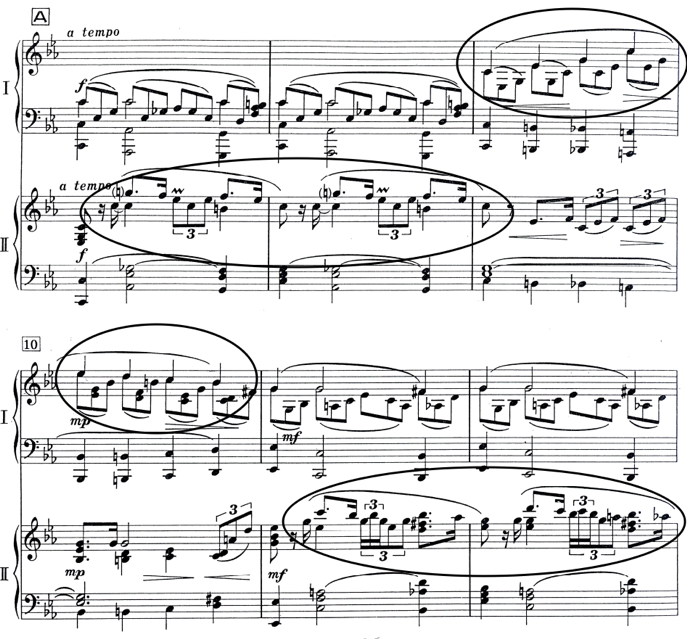
The theme of the main part of Xiao Taizhan's Concerto is tonally and thematically related to the themes of the main and side parts of the first movement of the Second Piano Concerto by S. V. Rachmaninoff. Just as in the composition of the Russian composer, the theme is presented in the key of C minor. By the type of texture, it is close to the main part of Rachmaninoff's masterpiece, and by the nature of the melodic pattern, it is a side part. The similarity can also be traced at the level of thematicism (verses 14-16), which is marked by a direct borrowing of the material of the main part of the Second Concert (verses 39-55) (Example 2).
Example 2
The binding batch (vol. 35) is based on the material of the main one. Tonal development (C minor – E major – E flat major – G major) leads to C major. The theme of the side part in the exhibition (vol. 74) is light and calm with a touch of determination, it is performed by a solo oboe and turns into a piano part (Example 3). The first piano cadenza (vol. 107) is based on fast passages, acting as a link to the second theme of the side part.
Example 3
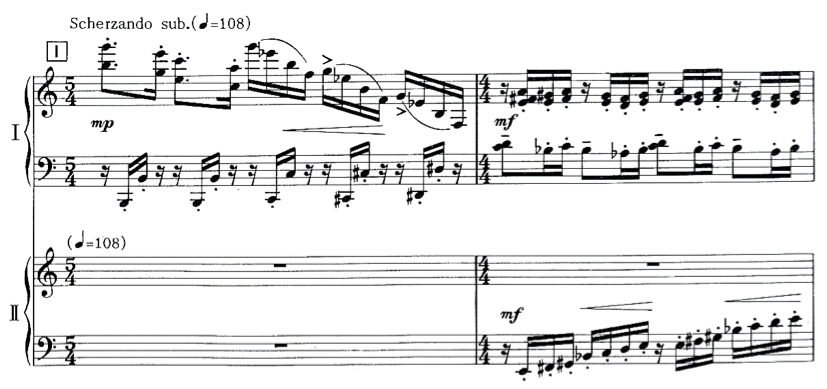
The final batch (vol. 138) is based on the material of the secondary. In the development, woven from various musical fragments, the theme of the side part is also used as the main element of the development. The thematic material is diverse, tonal shifts are rapid, and collisions of various sections are extremely intense. Based on the thematic material and the nature of the music, the development can be divided into five sections: Section 1 (volumes 152-164); section 2 (volumes 165-182); section 3 (volumes 185-202); section 4 (volumes 203-218) and section 5 (volumes 219-238). In the light, scherzosic first section, the composer uses expressive techniques (frequent and rapid change of clock sizes, ostinate figures, etc.) to demonstrate the virtuoso capabilities of the piano (Example 4).
Example 4
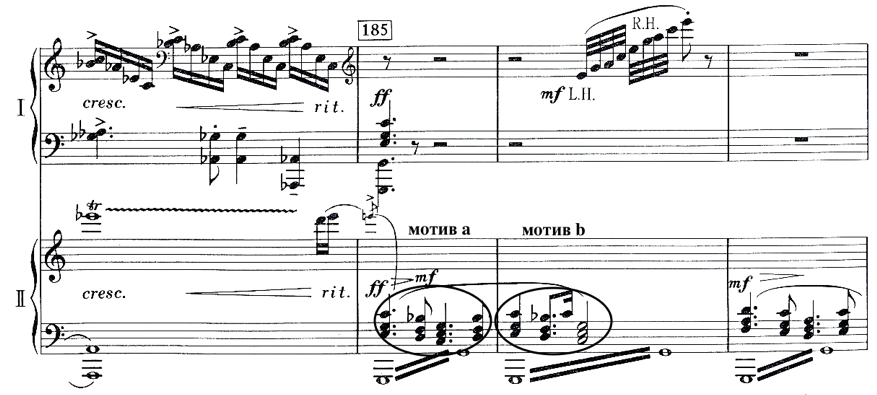
The second section is calmer, based on the development of the intonations of the side part and marked by the transition of the tonal center from g major to G minor. In the third section, the nature of the music changes rapidly: from harsh to lively and light, and then to excited. It is noteworthy that it is at this point in the score that the composer introduces the scherzo rhythmic motifs from the main part (Example 5), which form the basis of musical development and form a new character of musical imagery. The same scherzo motifs appear in the reprise (vol. 291-294), when moving to the coda.
Example 5
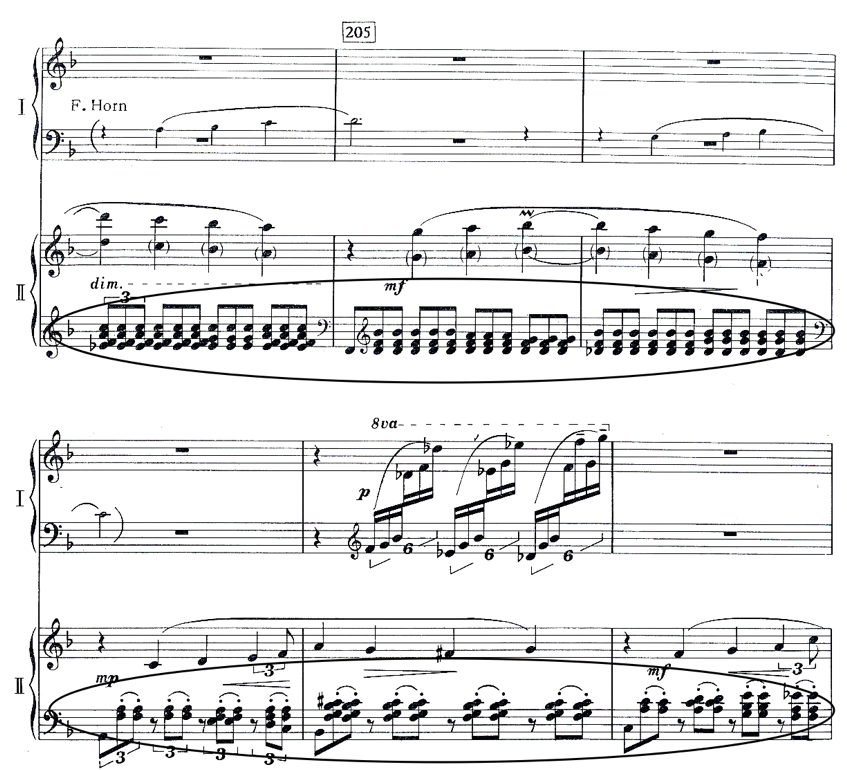
The fourth section continues to develop the intonation of the side part. The tonal center shifts to F major. The string band of the orchestra uses a rhythmic figure of trioles on one note, which gives the melody a smoothness (Example 6).
Example 6
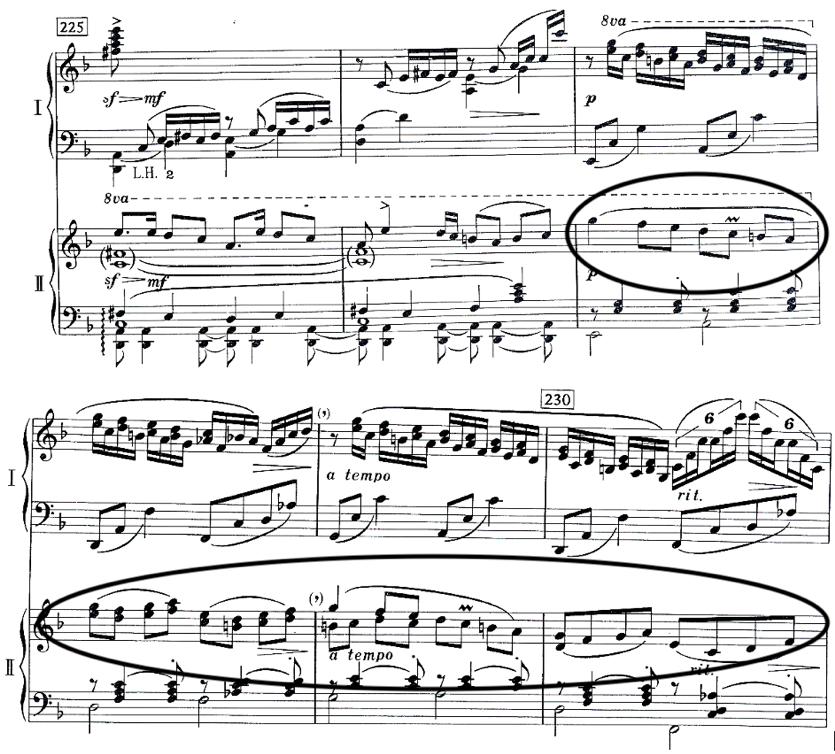
The fifth section (F major) – arpeggiated piano chords combined with the syncopated rhythm of the orchestra create the effect of rhythmic compression and acceleration of movement. In verses 227-230, the theme of the side part reappears in the orchestra (Example 7). This is followed by a dynamic build-up leading to the onset of the reprise.
Example 7
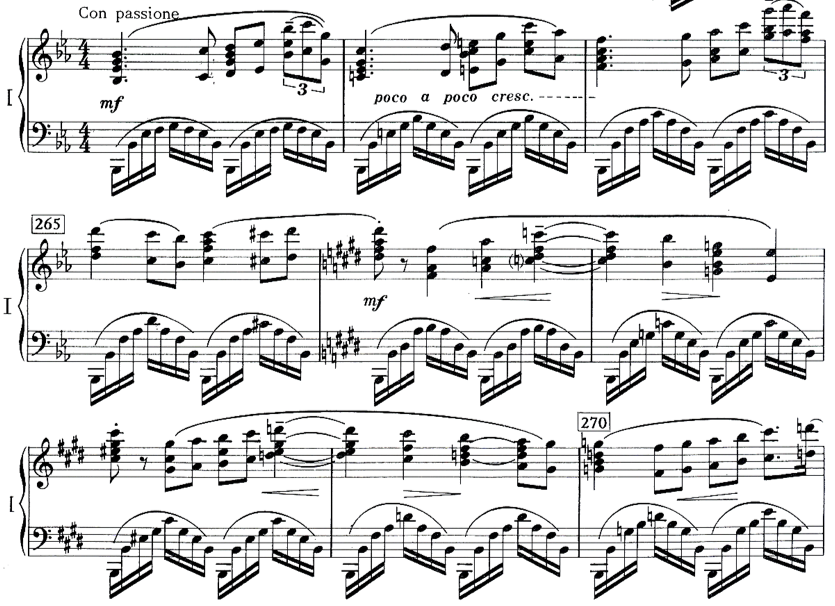
In the reprise of Part I, the main themes are in the key of C minor. The second cadence (vol. 261) consists of two dissimilar constructions. The first (tempo rubato) creates a kind of mystical atmosphere and performs the functions of an introduction. In the second section (con passion), the chord compaction of the melodic line is widely used (Example 8), which is related to the piano texture of S. V. Rachmaninov's Second Concerto.
Example 8
The side part (vol. 275) is played in C minor, and its conducting (vol. 279) is entrusted to the oboe and flute. The reprise uses material from the third and fourth sections of the development (volumes 283-309), as well as elements of the main batch (volumes 291-294) (Example 9).
Example 9
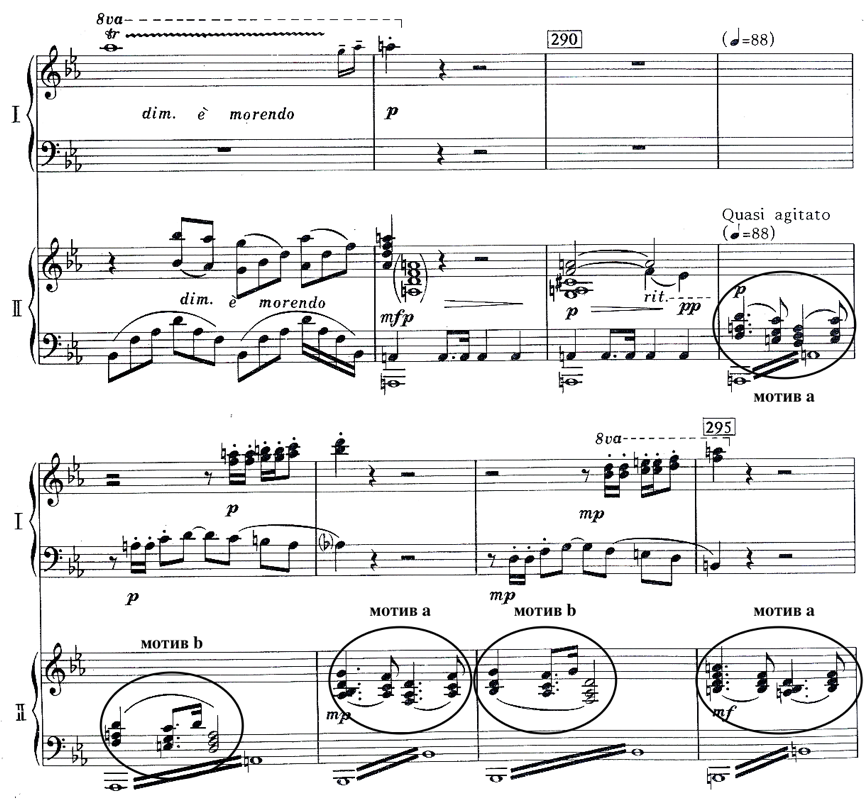
The code (vol. 310) uses the musical material of the theme of the main part. Then, starting from bar 316, the opening theme is played in the orchestra (Example 10). Returning, the main motif of the main part reaches the climax of ff and part I ends with the same timpani beat as it opened.
Example 10
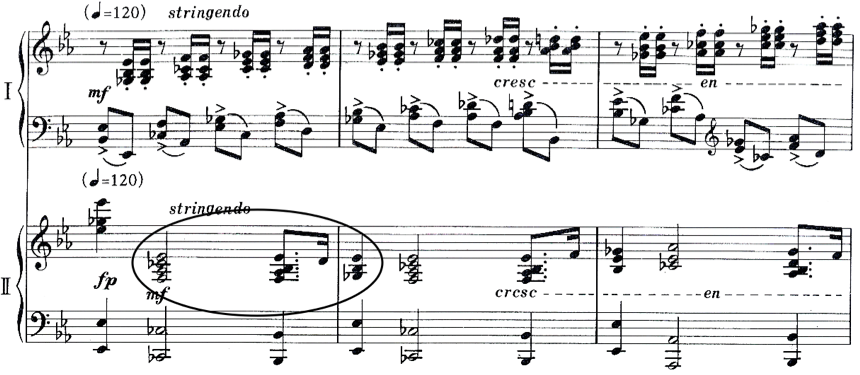
The second part (a-moll) is written in the form of a rondo. This romantic Adagio reveals the features of the piano ballads of F. Chopin and I. Brahms and is close in style and texture to the "Songs without Words" by F. Mendelssohn. The repetition of the theme of the side part establishes a connection with the first part of the Concert, however, unlike the first part, which lacks elements of musical folklore, Adagio quotes the theme of the Taiwanese folk song "The Heart is bitter" ("心酸酸"). The music expresses love for Xiao Taizhan's native land. The theme of the refrain, section A (verses 1-11), is presented first by the clarinet (verses 1-3), then by the string group (verses 4-8) and then by the piano, which creates the effect of a consistent accumulation of emotional saturation (Example 11). In the future, the theme of the refrain is repeated four times.
Example 11
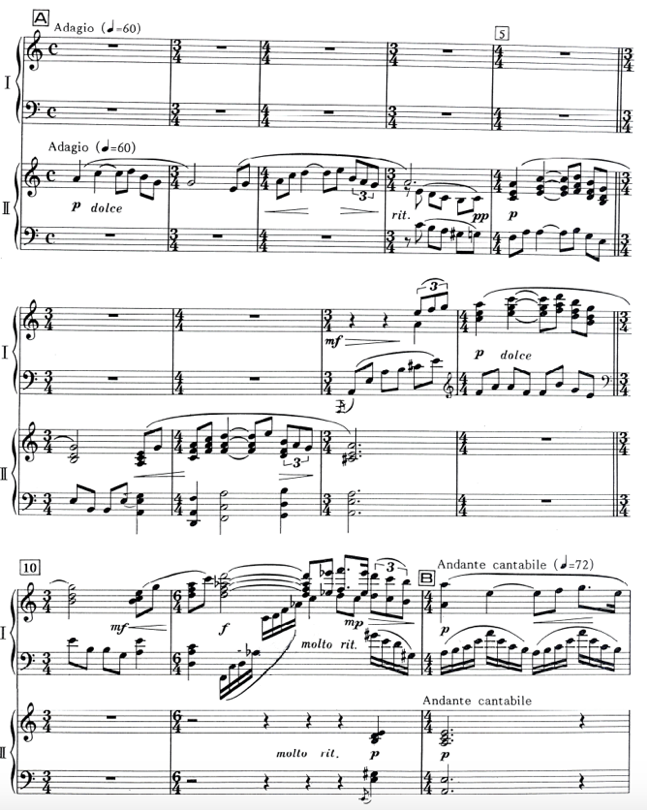
In the first episode (B), in A minor (vol. 12-22), a new theme is played in the piano part, then repeated by the orchestra (Example 12).
Example 12
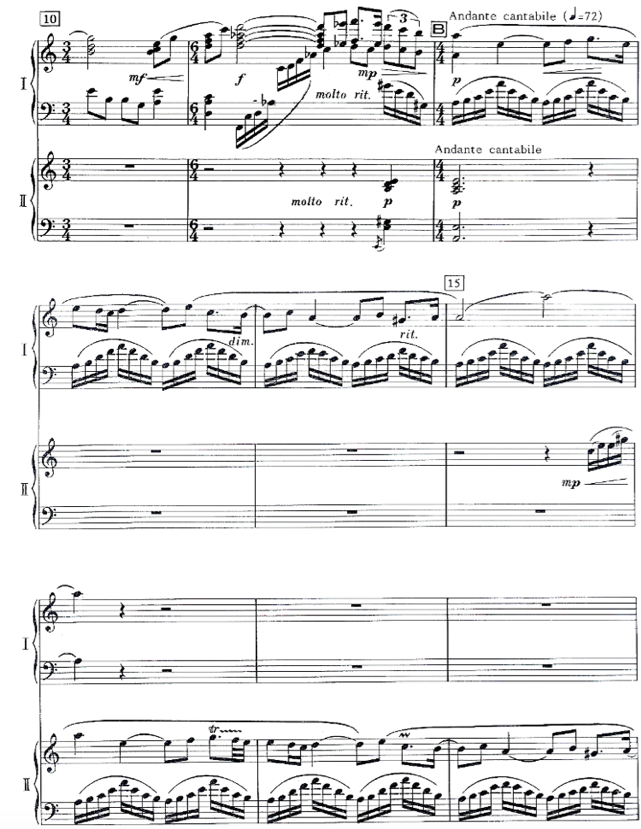
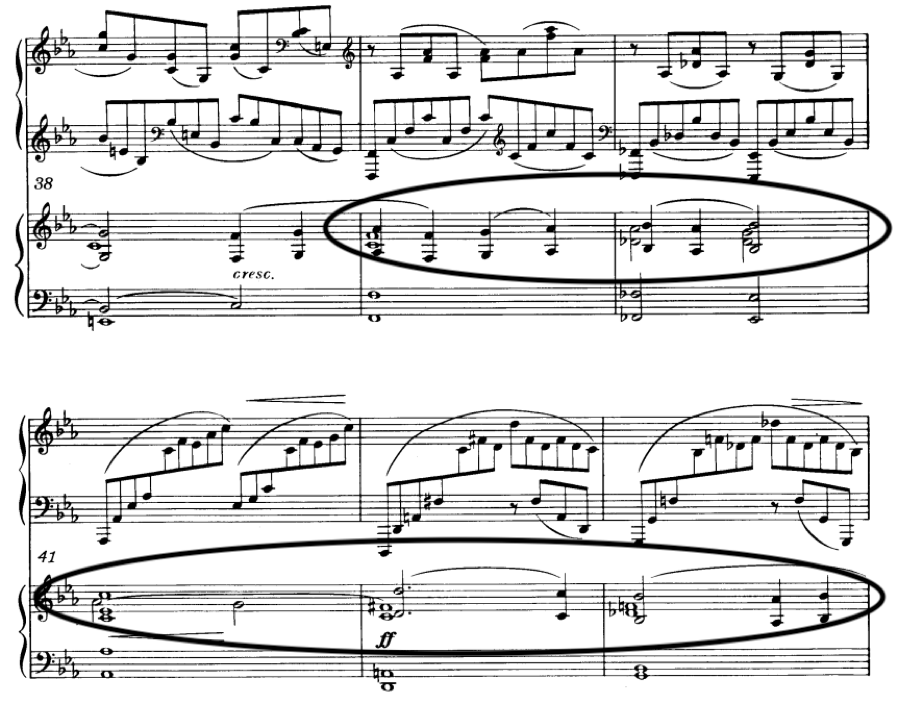
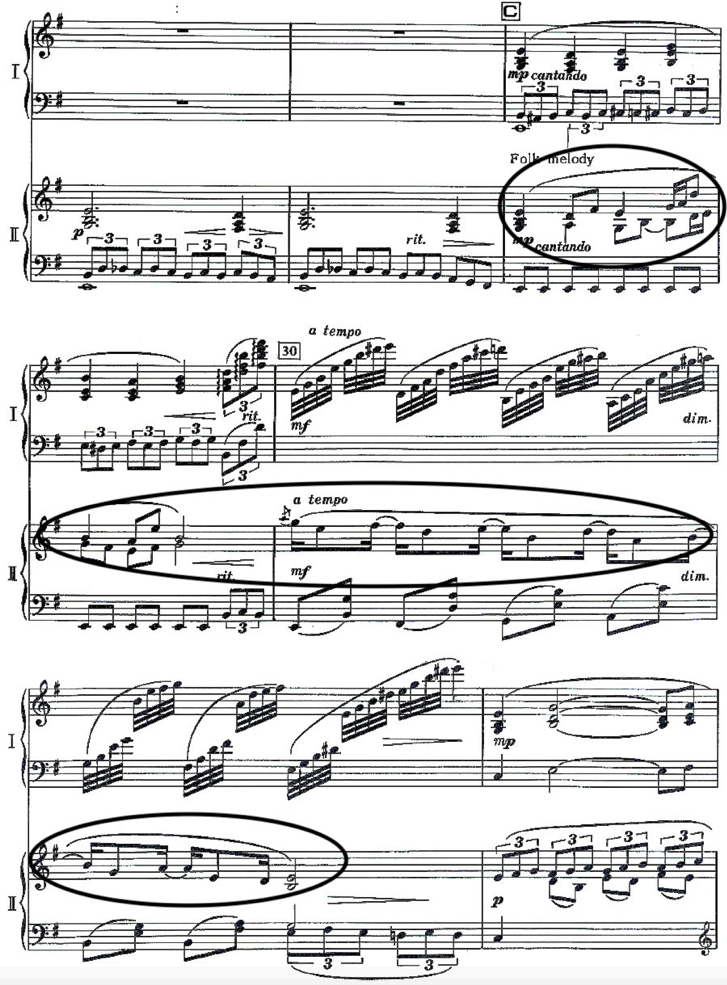
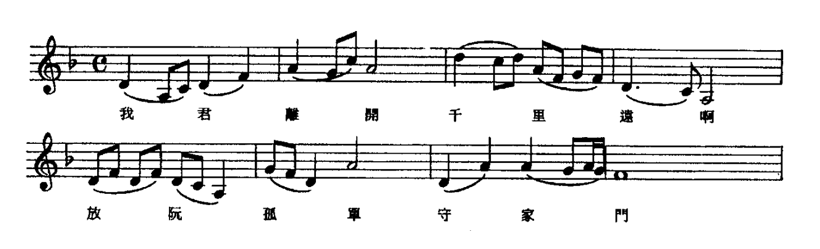
After the contrasting episode, the refrain A (verses 23-27) is played in E minor. The melodic pattern of the following episode C (verses 28-43) is close to the outline of the Taiwanese folk song "The Heart is bitter" (Example 13-14).
Example 13
Example 14. "My heart is bitter"
In this episode, the theme is led by the orchestra, while the piano part is given an accompanying role. The chromatic ascending trioles of piano passages stabilize the rhythmic pulsation and condense the musical fabric.
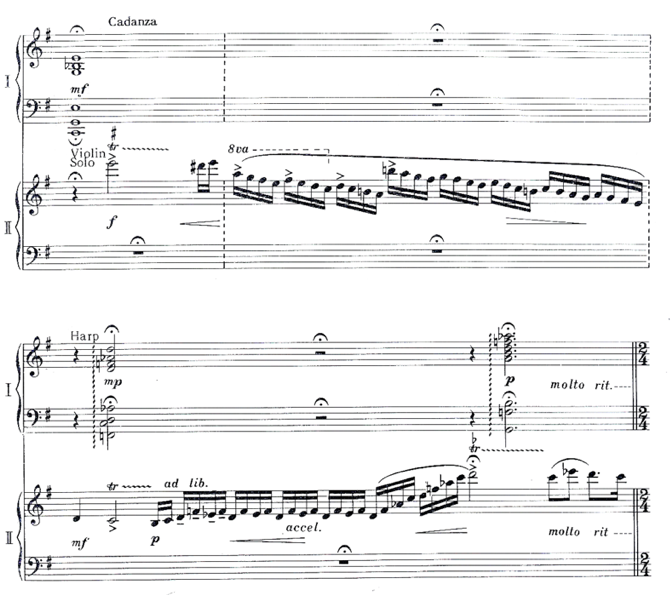
The theme of the refrain takes place in a transformed form and leads to the E minor Cadence I (verses 44-48). She is assigned to a solo violin, the sound of which is intended to express the composer's sense of nostalgia for his Homeland (Example 15).
Example 15
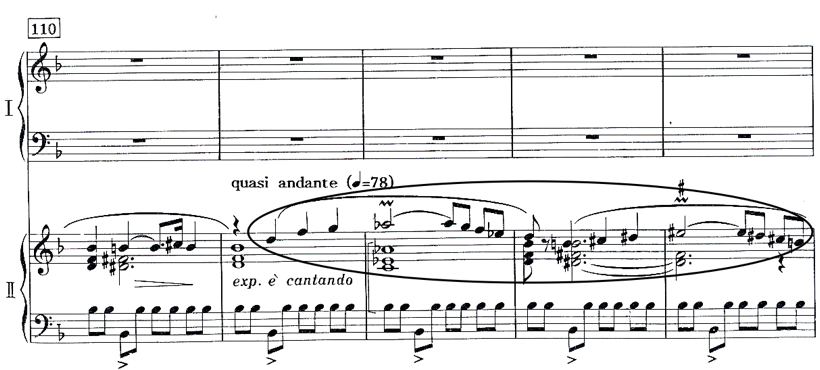
The rather large–scale episode D can be divided into five sections: the first is tt. 49-84, the second is tt. 85-110, the third is tt. 111-128, the fourth is tt. 129-135 and the fifth is tt. 136-149. In the first section (Allegro con moto), there is a modulation from E minor to G major, the metric increases – the size changes from 4/4 to 2/4, the rhythm becomes more elastic, the music acquires a scherzo character. In the second section (Allegro moderato – Andante), the theme is conducted by strings, two-part is replaced by three-part (from 2/4 to ¾), the rhythmic movement becomes more calm – all means are aimed at recreating the picture of carefree rural life and scenes of children's games [5, p. 56]. In the third section, the theme of the side part from Part I is repeated in the orchestral part (Example 16).
Example 16
The fourth section (Andante cantabile) returns to the theme of episode B. The fifth section performs a connecting function: arpeggios, trills and trioli of the piano part prepare cadenza II. In the cadenza (vol. 150-154), the high-pitched piano sounds recreate the waves spreading across the water from a falling drop, metaphorically depicting the composer's emotional excitement and his memories of the past. In vols. 155-157, the theme of section A (in A minor) is repeated. Then, in verses 163-171, the theme of the side part from the first movement takes place in the orchestra part. In volume 172, the coda begins – Recitative lento (in A minor). In the upper voice of the piano part, descending movements appear on a reduced fifth, which stop at the dominant third chord (with a missing septima) in the key of A major (Adagio). After a free tremolo built on a tritone, the dynamics gradually fades to pp and the second part ends (Example 17).
Example 17
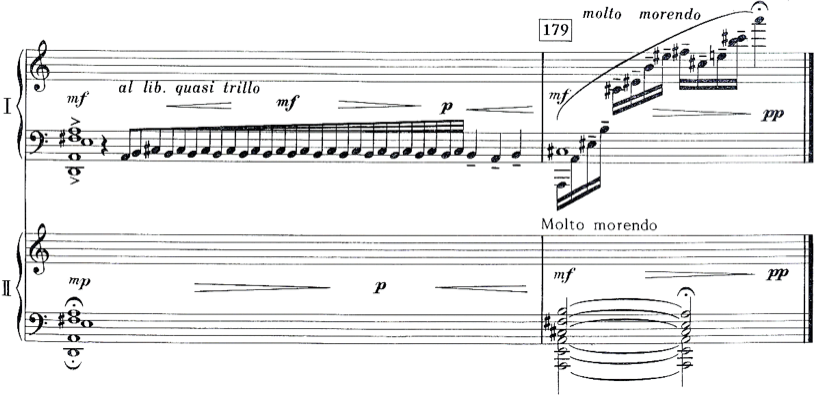
The third part (Finale) is written in three-part form with a dynamized reprise (ABA1) and a coda. The introduction, as in the first part, opens with timpani. The piano part is represented by chords with wide jumps (vol. 2) and arpeggio passages in the rhythm of the sixteenth (Cadenza I), which gives the texture a high degree of virtuosity. In section A (in C minor), the orchestra conducts the main theme, which is a new version of the melody of the song "The Heart is bitter", which acquires a marching character with an elastic rhythm and a powerful, decisive sound (Example 18).
Example 18
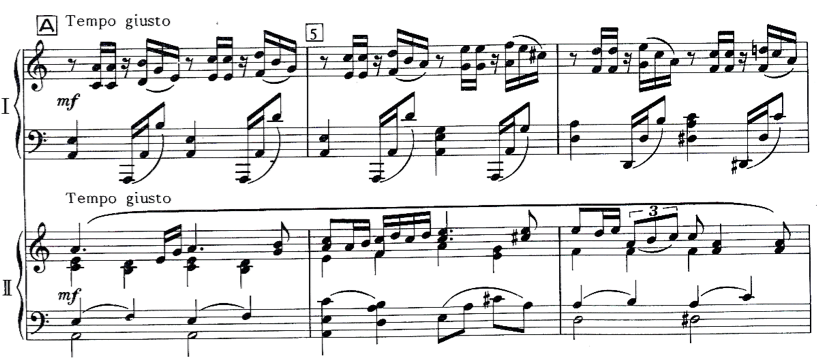
In verses 34-41, the composer preserves the marching character of the music by using the material in section A in rhythmic magnification. The texture is based on powerful chords and octave doublings, similar to the texture of the piano part of the aforementioned S. V. concerto. Rachmaninoff. 42-55 introduces a connecting episode and a concluding theme. The final theme is designed in a romantic, free fantasy style and a slower tempo (Example 19).
Example 19
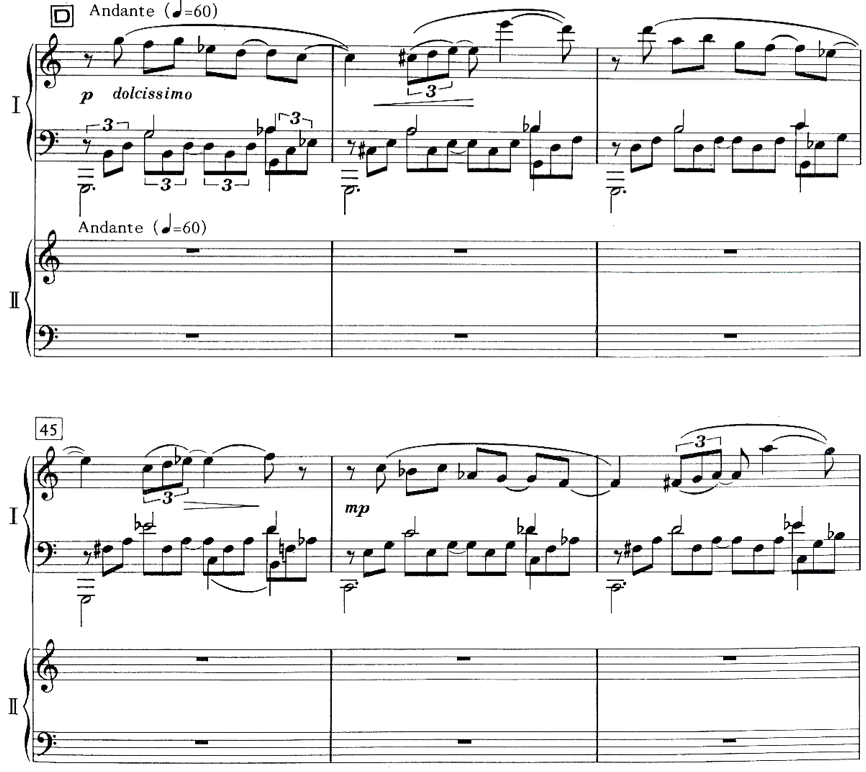
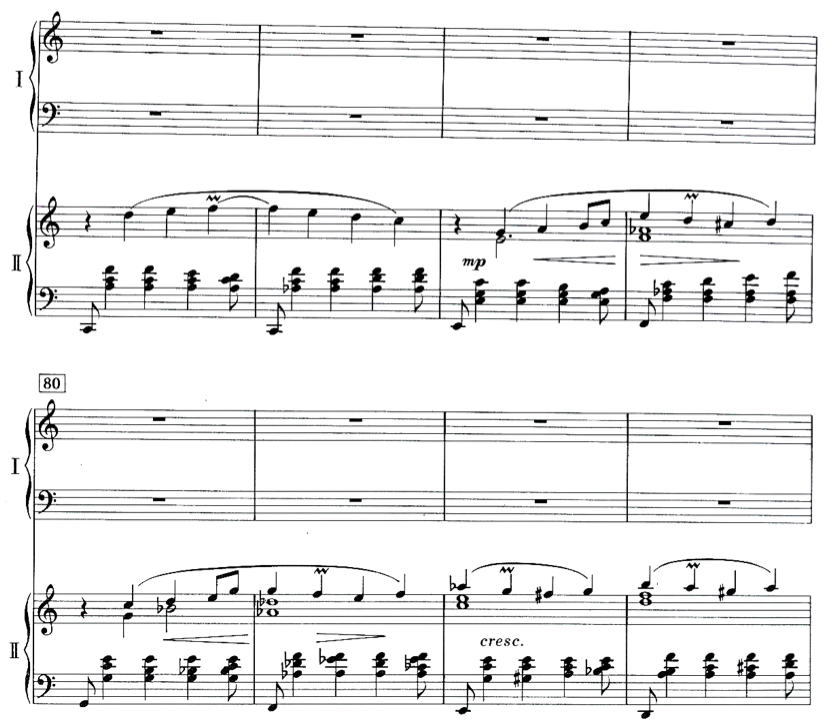
The main key of section B (verses 56-119) is in E-flat major. Here, the theme is conducted sequentially, first by the solo flute, and then by the piano. In the process of development, the character of the theme becomes agitatedly rapid (agitato), and then gradually calms down (molto espressivo). Interestingly, Cadenza II, introduced in this section, was written by Milton Stern, a lecturer at Xiao Taizhan at California State University in Los Angeles. The intonations of the second section of the Finale served as the material for Cadenza II. The composer does not do without folklore tunes in Part III either – in the connecting episode (vol. 103-119) he uses the melody of the Taiwanese song "The Sky is getting Dark" ("天""(Examples 20-21).
Example 20
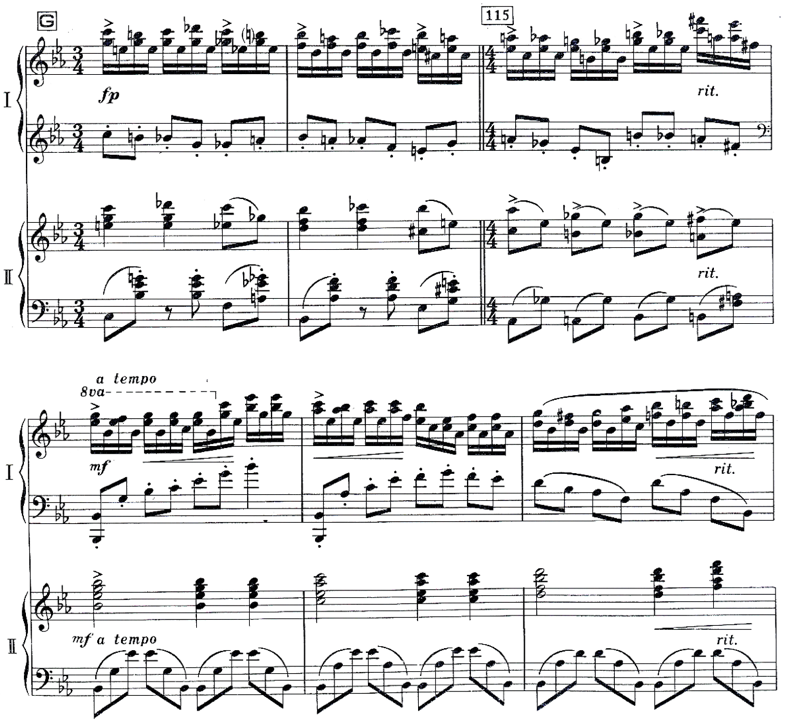
Example 21. "The sky is getting dark"
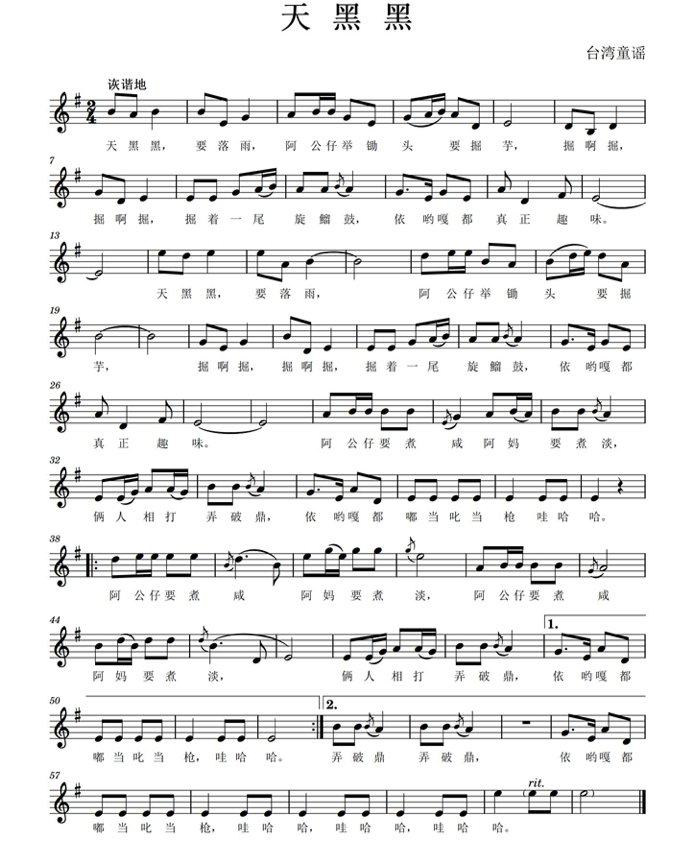
Section B ends with several episodes that prepare for the reprise. In the first (verses 120-144)– the theme "The heart is bitter" is varied using an ascending fifth movement. In the second (vol. 145-159), the theme of the introduction from the second part develops, expressing homesickness. In vol. 160-163, the rhythmic motif from the introduction to part I is used; its four-fold repetition with a steady dynamic increase leads to a reprise in vol. 164.
With the onset of reprise A1, the material of the first section returns with a repetition of the theme "The heart is bitter" and the connecting episode. In verses 193-229, the composer introduces a three-step coda, where at the first stage the theme "The heart is bitter" continues to develop (Example 22).
Example 22
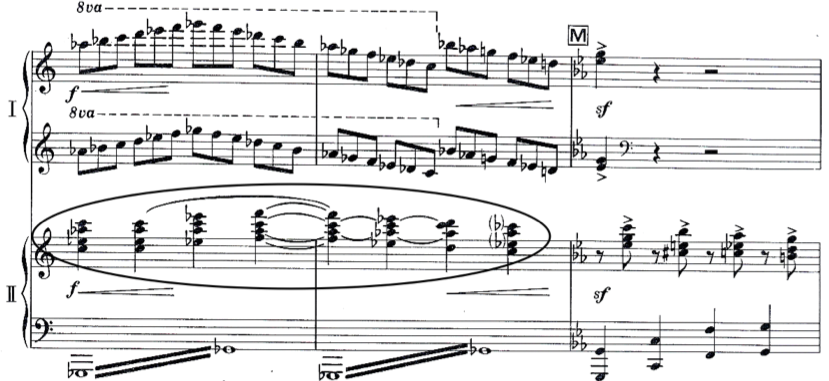
At the second stage (vol. 219-222), the theme of the main part from the first part returns, ensuring the thematic unity of the entire work. In the final fragment (verses 223-229), the orchestral texture thickens, the dynamics increase, and the Concert ends with a rapid fff of the entire sound (Example 23).
Example 23
Despite the variety of thematic elements used in Xiao Taizhan's concert, his language remains predominantly romantic. The noted direct quoting of theme elements and the use of a number of techniques (the key of C minor, changing the major and minor of the same name to achieve unexpected tonal contrasts) brings the concert of the Taiwanese composer closer to Rachmaninov's Second Piano Concerto. In the field of harmonic structure and sound coloring, both works widely use chords in close arrangement and dense texture, in particular, octave doublings in the piano part. This compositional method, in which melody and harmony organically merge into a single whole, is one of the most characteristic features of Rachmaninov's work.
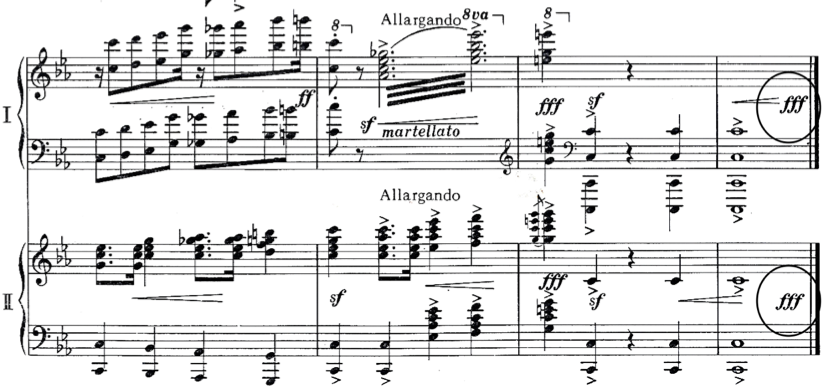
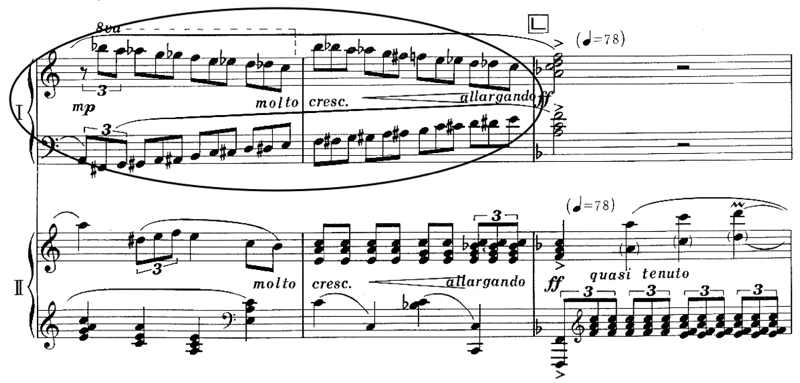
In handling the melodic line, Xiao Taizhan shows exceptional subtlety and sensitivity, leaving performing comments on the main themes of the concert ("espressivo" and "cantando"). The themes are clear, carrying an intense emotional load. Cantilence permeates the entire work. In addition, the Concert is distinguished by the richness of the harmonic palette. Xiao Taizhan widely uses chords at lower VI and VII steps, which not only corresponds in harmonic logic to Rachmaninoff's method of "expanding the subdominant function", but also inherits aesthetically his aspirations for drama and epic scope. In the cadence constructions, the concert uses a plagal turn (IV–I) characteristic of romanticism or an interrupted cadence in order to preserve the continuity of emotional development. To make modulation transitions, the composer often uses seventh chords, nonaccords, altered chords, and movements based on the sounds of the chromatic scale (volumes 201-202, I parts) (Example 24).
Example 24
Nostalgic notes are especially noticeable in the theme of the side part of the first movement, which runs through the entire work and serves as a leitmotif. Despite the presence of innovative elements, the overall structure of the work tends towards classicism. Structurally and in the orchestral composition, similar to Rachmaninov's Second Piano Concerto, Xiao Taizhan chooses a standard three-part structure of the classical-romantic type and a double composition of the orchestra, which creates the basis for the monumental sound of the work. Rachmaninoff was the first to apply the technique of equal alternation of the leading role between the piano and the orchestra. The second concert is similar in type to a lyrical poem, and the element of "concertness" (like a competition between a soloist and an orchestra) is practically absent in it [18, pp. 178-179]. The Taiwanese composer inherited and developed this principle.
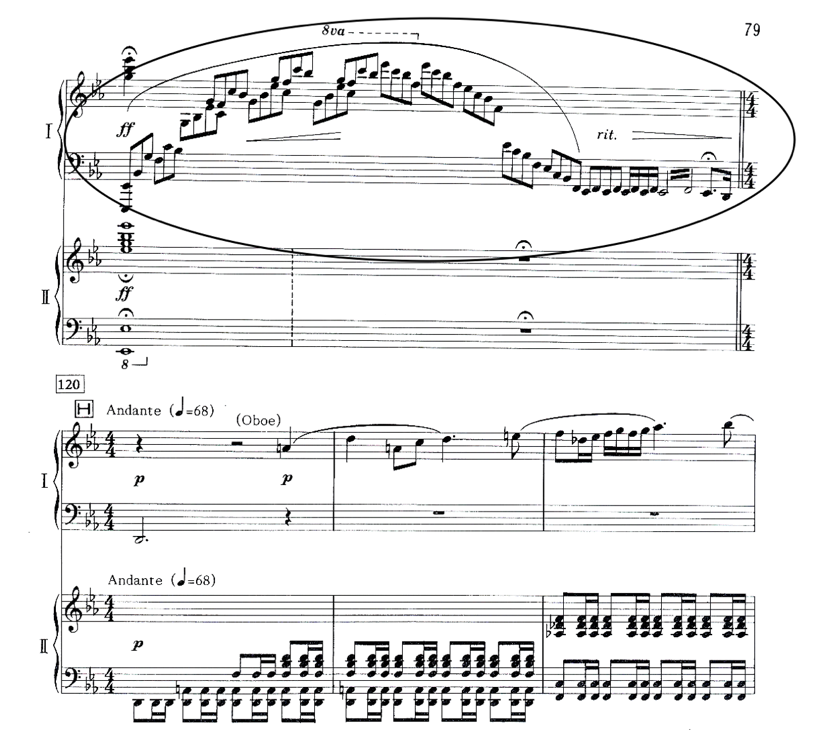
Along with the romantic features, the second feature of the concert's musical language is its pronounced national character, which makes up its identity. Its most striking manifestations include the processing of Taiwanese folk songs – "The Sky is darkening" and "The Heart is bitter" – the latter of which appears in parts II and III a total of six times. In some performances, it retains the lyrical, soulful character inherent in the original theme of the song, while in others it acquires a marching appearance. Among the elements of national culture used by the composer in the Concert, one should also mention the pentatonic (e-flat – fa – g– b-flat – do), on the basis of which, for example, the Third Cadence of the III movement is based (Example 25).
Example 25
Conclusion. Xiao Taizhan is one of the few modern Taiwanese composers who has managed to organically combine national and Western European musical traditions in the music of piano compositions. The central work in his legacy, the piano concerto, has a pronounced national character and a romantic style that conveys the nostalgic feelings of the composer who left his homeland. The creative approach based on the synthesis of Chinese and Western European musical traditions demonstrates the specifics of Xiao Taizhan's compositional thinking. Being Xiao Taizhan's most important piano composition, the Piano Concerto in C Minor, Op. 53, embodies the composer's central creative idea – the synthesis of Chinese and Western musical cultures and the popularization of Taiwanese academic music. The composer's citation of the Taiwanese folk songs "The Heart is Bitter" and "The Sky is getting Dark" defines national identity. The composer draws inspiration from Taiwanese folk songs, carefully processing them and organically weaving them into the fabric of the composition. The concert notes the influence of the music of S. V.'s Second Piano Concerto. Rachmaninoff, testifying to the importance of the legacy of the Russian composer in the development of academic musical culture in Taiwan. The introduction to the musical fabric of the concert quotes from the work of the Russian composer enhance the feeling of longing for the lost homeland.
Xiao Taizhan remains one of Taiwan's most popular composers. The composer's piano compositions have not lost their relevance, on the contrary, several decades after the composer created his famous compositions, listeners are able to appreciate their significance in the space of modern musical culture. Further study of the genre and stylistic nature of the composer's piano works will not only contribute to understanding his creative achievements, but can also serve as a guide for further study of Xiao Taizhan's creative legacy.
The article is published in its final version as approved following the last positive peer review recommending acceptance for publication. It incorporates revisions made by the author in response to prior negative peer review reports that did not recommend publication. All peer review reports, including initial negative reviews, are published in open access alongside the article. All versions of the author’s revisions are archived in the publisher’s repository and may be made available upon reasonable request in accordance with Elsevier’s editorial policies and applicable data availability requirements.
Read all reviews on this article
References
1. Yan Huarong. (2002). The romantic taste of Taiwan. Taipei: Cultural Times. (in Chinese)
2. Zhuang Wenda. (2012). Systematization and analysis of piano concertos by Taiwanese composers. Musicological Studies, 16, 25-62. (in Chinese)
3. Huang Wanshu. (2007). A study of the Taiwanese composer Tyzen Hsiao and the performance aspects of his piano concerto in C minor op. 53. D.M.A Document. University of Miami.
4. Chang Linmin. (2018). A study of Tyzen Hsiao's Piano Concerto, Op. 53: A comparison with Rachmaninoff's Piano Concerto No. 2. D.M.A Document. The Ohio State University.
5. Lin Hengzhe. (1999). Tender romantic: Anthology of the musical world of Tyzen Hsiao. Taipei: Wanchunfeng. (in Chinese)
6. Tsai Mingyun. (2006). World-class Taiwanese musician-Tyzen Hsiao. Taipei: Jade Mountain. (in Chinese)
7. Sun Shuwen. (2006). The piano works of Tyzen Hsiao: An exploration of context, technique, and style. Taipei: Donghe. (in Chinese)
8. Liu Ketin. (2019). Stylistic dominants of Chinese art in the 20th century and the artistic practice of Taiwan. Notes on Art Criticism, 35, 235-240.
9. Liang Maochun. (2007). Towards a comprehensive study of music history: On the study of music in Taiwan and Hong Kong. Art of Music, 2, 63-72. (in Chinese)
10. Zhao Guanghui. (1998). Continuity, periodization, and evolution of Taiwanese music. Art of Music, 4, 4-6. (in Chinese)
11. Wang Qiyue. (2025). Features of the formation and development of the musical art of the Western European tradition in Taiwan. Scientific and Analytical Journal "House of Burganova. Space of Culture," 21(6), 75-84.
12. Lu Yuxiu. (2003). History of music in Taiwan. Taipei: Wunan. (in Chinese)
13. Schudson, M. (1994). Culture and the integration of national societies. International Social Science Journal, 1, 63-82.
14. Sangren, P. S. (1984). Great tradition and little traditions reconsidered: The question of cultural integration in China. Journal of Chinese Studies, 1, 1-24.
15. Xiao Di. (2022). A study of the development of minority music in the context of multicultural integration. Journal of Jishou University (Social Sciences Edition), 2, 132-138. (in Chinese)
16. Hu Bin. (2010). Cultural identity: An important theoretical perspective in music anthropology. Musical Art (Journal of Shanghai Conservatory of Music), 3, 70. (in Chinese)
17. Li Wenjun. (2008). "Each is beautiful in its own way, and the beauty of others"-The practical significance of national culture reconstruction and postcolonial theory. Ningxia Social Sciences, 6, 193. (in Chinese)
18. Keldysh, Y. V. (1973). Rachmaninoff and his time. Moscow: Music.
First Peer Review
Reviewer: Mikhailova Alevtina Anatol'evna, Doctor of Art History; Professor, Head of the Department of Folk Singing and Ethnomusicology, Saratov State Conservatory named after L.V. Sobinov
DOI:10.25136/review.36786
The reviewed article is "Piano Concerto in C Minor, Op. Xiao Taizhan's 53 in the Context of Taiwan's Musical Culture" is devoted to the analysis of the piano concerto in C Minor, Op. 53 by the Taiwanese composer Xiao Taizhan (1938-2015). The subject of the study is the compositional features of the work, its stylistics, as well as the ways in which elements of Taiwanese folk music and Western European academic tradition interact in it. The work considers the concert as a significant phenomenon of Taiwanese musical culture at the end of the 20th century. The author uses a comprehensive methodological approach combining the historical and cultural method (consideration of the biographical context, the history of the creation of the work and its place in the development of Taiwanese music) with the methods of musical analysis. Among the latter, structural and functional analysis (the study of the shape of the parts of the concert, their thematic structure), stylistic analysis (identification of romantic features and connections with the work of S. V. Rachmaninov) and harmonic analysis (the study of chord vertical, modulation techniques) are used. This approach allows us to consider the work both at the level of macrostructure and at the level of detailed musical fabric. The relevance of the research topic is due to the fact that Xiao Taizhan is a key figure of Taiwanese academic music, and his piano concerto, created in 1992, represents the pinnacle achievement in this genre. As the author rightly notes, the score of the work remains difficult to access, which limits the number of analytical papers. In the context of increasing interest in the musical cultures of East Asia and the processes of cultural synthesis, a comprehensive study of this concert fills this gap in modern musicology. The scientific novelty lies in the fact that the article contributes to the study of Xiao Taizhan's work through a detailed compositional analysis of the concert. The author consistently examines all three parts, revealing the features of their form, thematism and harmonious language. The work convincingly demonstrates the synthesis of the romantic tradition dating back to S. V. Rachmaninov, with elements of Taiwanese musical folklore – quoting and processing folk songs "The Heart is bitter" and "The Sky is darkening", as well as the use of pentatonics. Special attention should be paid to tracing the thematic connections between the parts, which allows us to speak about the leitmotif unity of the work. The article is written in clear academic language, logically structured. The literature review convincingly shows the degree of elaboration of the topic and justifies the need for the analysis undertaken. The main part contains a detailed analysis of all parts of the concert, indicating the bars, which makes the analysis clear and evidence-based. The presence of musical examples significantly increases the scientific value of the work. The author successfully shows how a composer, combining a dialogical manner of presenting thematics with a virtuoso piano texture, creates an individual style that combines nostalgic tonality and vivid national flavor. The list of references is quite representative and includes both fundamental works on the history of Taiwanese music (Liu Yuxu) and specialized research on the work of Xiao Taizhan, including dissertations (Huang Wanshu, Chang Linmin). The use of sources in Chinese is an absolute advantage of the work, which allows the author to rely on authentic scientific material. However, the bibliography lacks works critically reflecting on the phenomenon of "national style" in music of the XX–XXI century and the concept of "Westernization" of East Asian cultures, which somewhat narrows the theoretical context of the study. The article is structured as a polemic in relation to the existing research tradition, which, in the author's opinion, is either limited to biographical information, or considers the concert mainly in the performing aspect. The author rightly claims that his work focuses on compositional features that have not previously been the subject of close analysis. As comments and recommendations: 1. Despite the consideration of the concert in the context of Taiwan's musical culture stated in the title, the author mainly restricts himself to analyzing the work itself, only occasionally referring to the context – a broad cultural and historical background. The connection of the concert with the historical situation in Taiwan, for example, with the "February 28 incident" of 1947, remains not fully disclosed. 2. Insufficient understanding of the dialogue with Russian and Western traditions. The author consistently traces the influence of Rachmaninoff's Second Concerto on Xiao Taizhan's composition, however, this line is drawn mainly at the level of stating borrowings and similarities. A deeper analysis of exactly how the Taiwanese composer rethinks and transforms Western European models (as opposed to the simple imitation that some critics insist on) has remained undisclosed. 3. One-dimensionality of the analysis of the interaction between the soloist and the orchestra. The article quotes the composer's vivid metaphor of "the swimmer and the sea," but the musical analysis of this interaction is limited to stating dialogical phrases and the division of thematic material between the soloist and the orchestra. The reviewed work should focus in more detail on how the balance between piano and orchestra changes during the concert, and how this reflects the author's concept of the genre, despite the fact that some researchers point to a more "chamber" nature of interaction in Xiao Taizhan's concert compared to the Rachmaninoff model. 4. The problem of terminological accuracy. In the final conclusions, the author speaks about the "Chinese" folk tradition, although the main part of the article consistently deals specifically with Taiwanese folklore. This terminological carelessness (substituting "Taiwanese" for "Chinese") creates conceptual ambiguity, especially in the politically sensitive context of Taiwan's cultural identity. The article is a qualitative study that makes a significant contribution to the study of Xiao Taizhan's piano work. A detailed compositional analysis of the concert, the identification of its national origins and connections with the romantic tradition are the indisputable advantages of the work. The article can be recommended for publication in a scientific journal after revision, taking into account the comments made. When preparing the final version of the text, the author is recommended to: expand the cultural and historical context, including a discussion of the social and political factors of the formation of Taiwanese identity; deepen the analysis of the reinterpretation of Western European musical models, proposing criteria for assessing the originality of the composer's idea; clarify terminology, consistently distinguishing the concepts of "Taiwanese" and "Chinese" musical material; perhaps supplement the bibliography with works on the theory of cultural synthesis and the implementation of national musical traditions, as well as to involve Western studies on the work of Xiao Taizhan and the analysis of his works.
Second Peer Review
Reviewer: Pavlova-Borisova Tat'yana Vladimirovna, PhD in Art History; Associate Professor, Department of Culturology, Ammosov North-Eastern Federal University
DOI:10.25136/review.37048
The subject of the research by the author of the article is not clearly defined in the text submitted for review. Based on the title of the material, it is clear that the subject of the study is the piano Concerto in C Minor, Op.53 by Xiao Taizhan in the context of Taiwan's musical culture. According to the author, the research methodology is based on a historical and cultural approach, methods of musical textual analysis and musical analysis (structural-functional, stylistic, harmonic).The historical and cultural approach is not deep enough, as is the stated musical analysis, which does not include enough references to "substantiating the role of elements of the Taiwanese national tradition in the musical language of this composition." descriptive language prevails. The biographical method is applied. The relevance of the article is determined by the significance of the piano work of Xiao Taizhan (1938-2015), one of the most representative Taiwanese composers of the XX – early XXI century, the first representative of the Taiwanese national school, for the culture of the East Asian region. The scientific novelty takes place in identifying the features of the formation and musical stylistics of this work. An overview of the sources on the research topic is given, according to the results of which the objectives of this study are "to analyze the Concert in terms of its compositional features, substantiate the role of elements of the Taiwanese national tradition in the musical language of this composition, determine the author's approach, which allowed Xiao Taizhan to create a work of art in a romantic style and at the same time preserve a pronounced nationality." The style of presentation should be described rather as popular, even in analytical sections, descriptive character prevails. The structure includes a detailed introduction, a lengthy main part and a brief conclusion. Analytical sections, although they are decorated with musical illustrations, need to be given a purposeful analysis - what feature of Taiwanese music is revealed in a particular theme, the song "Heart is bitter" as represented in the traditional musical culture of Taiwan, which of the composers was quoted earlier or not? What is Xiao Taizhan's attitude to the work of S. Rachmaninov - is this his conscious "kinship" with the piano music of this composer? How are stylistic similarities with the piano music of Romantic composers revealed?Chopin, J. Brahms, F. Mendelssohn? The author points to "Xiao Taizhan's special attitude to the harmony, texture, and rhythm of Impressionism and modernism of the early twentieth century," but there are no references or justifications for these conclusions in the text. Bibliography - includes mainly Chinese sources. If a comparative study is conducted with the music of romantic and impressionist composers, then it is necessary to expand the range of sources on their work, including in Russian. There is an appeal to the opponents, and it is detailed enough in the introduction. Conclusions need to be expanded and adjusted, and they should be summarized in the analysis process. The interest for the readership takes place after a significant revision of the text of this study submitted for review.
Third Peer Review
Reviewer: Gritsai Lyudmila Aleksandrovna, Doctor of Pedagogy, PhD in Pedagogy; Associate Professor of the Department of Socio-Humanitarian Disciplines, Ryazan Branch of Moscow State Institute (University) of Culture
DOI:10.25136/review.37439
The reviewed article is devoted to the study of the Piano Concerto in C Minor, Op. Xiao Taizhan's 53 in the context of the musical culture of Taiwan is a musicological work focused on identifying the features of the compositional structure of the work, the nature of the interaction of national musical traditions and the Western European academic model, as well as determining the artistic principles underlying the author's compositional thinking. The subject of the study is formulated quite clearly and corresponds to both the title of the article and the content of the main text, since the author's attention is focused not only on analyzing the structure of the concert, but also on considering it in a broad cultural and historical context, which makes it possible to link the features of the musical language of the work with the processes of formation of the modern Taiwanese school of composition. The methodological basis of the study appears to be generally sound and consistent with the objectives set. The author points out that the work uses methods of historical, source studies, textual, musical theoretical and comparative analysis, as well as methods of cultural studies and ethnomusicology, while these approaches are indeed reflected in the text of the article. The musical theoretical analysis is particularly consistently implemented, since a significant part of the research is devoted to the consideration of the composition of all three parts of the concert, their thematic development, tonal plan and features of the drama. Thus, the author analyzes in detail the structure of the first movement, noting that "the theme of the main part of Xiao Taizhan's Concerto is connected tonally and thematically with the themes of the main and side parts of the first movement of S. V. Rachmaninov's Second Piano Concerto," and also points to "direct borrowing of the material of the main part of the Second Concerto." Such observations are accompanied by references to musical examples, which reinforces the reasonableness of the conclusions. The relevance of the research is beyond significant doubt, since the author convincingly shows that the Piano Concerto in C Minor, Op. 53 remains a relatively little-studied work, despite the importance of its author for the musical culture of Taiwan. It seems reasonable to assert that "until now, due to the inaccessibility of the score, this work has not received wide coverage in research papers," as a result of which the appeal to the compositional features of this composition fills a certain gap in modern musicology. At the same time, the relevance of the article is determined not only by the lack of elaboration of the topic, but also by the growing interest in the interaction of national musical traditions and European academic culture. The scientific novelty of the research lies primarily in a comprehensive examination of the work, combining historical, cultural and musical analytical approaches. The author does not limit himself to describing the biographical circumstances of the creation of the concert, but seeks to show the mechanisms of artistic synthesis of various musical traditions. In particular, it is noteworthy that "national identity is determined by the composer's quoting of the Taiwanese folk songs "The Heart is bitter" and "The Sky is getting dark"," and this position is confirmed by a consistent analysis of the thematic material of various parts of the concert. At the same time, it should be noted that the individual conclusions of the article to a certain extent develop the already existing provisions of modern literature and therefore do not always have a pronounced degree of originality, but together the work forms an independent research concept. The style of the article meets the requirements of scientific presentation. The material is presented consistently, special musicological terminology is used, the argumentation is based on the analysis of the musical text and the involvement of research literature. The structure of the article also looks logical and includes an introduction with a statement of the problem, a thorough review of the literature, a description of the methodology, the main analytical part and the conclusion. At the same time, the volume of the section devoted to a detailed description of the composition of individual parts of the concert is sometimes excessive in relation to analytical generalizations, as a result of which the study acquires a predominantly descriptive character. For example, the author lists in detail the sequence of thematic sections of the development, indicating that "the development can be divided into five sections," however, the interpretation of the functional meaning of such a division could be disclosed more deeply. The bibliography of the article makes a favorable impression due to the combination of Russian, Chinese and English-language sources, including monographs, dissertation research and scientific articles. The presented literature review demonstrates the author's good knowledge of the modern historiography of the issue and makes it possible to convincingly show the degree of development of the topic under study. It should be noted that the links are organically integrated into the text of the study and are not used formally, but as a basis for subsequent analysis. The appeal to the existing scientific positions is correct. The author examines in detail the works of his predecessors, compares various research approaches and explains in a reasoned manner what is the difference between his own research. So, after reviewing the works of various authors, it is concluded that "the research of both Western and Chinese scientists... they do not affect the peculiarities of the formation and musical style of the Concert itself," which motivates the need for this research. At the same time, the polemical component is expressed moderately and corresponds to the genre of the academic article. The main conclusions of the article follow logically from the analysis and are generally convincing. The author consistently shows that the musical language of the work is formed as a result of the interaction of the romantic European tradition and national Taiwanese elements, confirming this position with concrete examples, including the use of the songs "The Heart is bitter" and "The Sky is getting dark", the appeal to pentatonics, as well as numerous parallels with the Second Piano Concerto by S. V. Rachmaninov. It is significant that the author quotes the words of the composer himself: "The piano is like a swimmer in a raging sea, and the orchestra is the sea itself with its waves and wind," demonstrating the connection of the artistic idea with the peculiarities of musical drama. The article is of interest primarily to specialists in the field of musicology, the history of academic music, comparative art history, ethnomusicology, as well as researchers of modern East Asian musical culture. The research materials may be in demand when studying the processes of interaction between national traditions and the Western European school of composition, as well as when analyzing the work of Xiao Taizhan and the development of Taiwanese academic music. The advantages of the article include a clearly formulated subject of research, a consistent structure of presentation, the use of a wide range of sources, a thorough analysis of musical material, the involvement of a large number of musical examples and the correct use of scientific literature. At the same time, some analytical statements could be presented in a more generalized form, and interpretative conclusions in some cases deserve additional development. In general, the article meets the requirements for scientific publications in the specialty, has a sufficient level of scientific argumentation, has theoretical and practical significance and can be recommended for publication in a scientific journal.
|

 Eng






 © 1998 – 2026 Nota Bene. Publishing Technologies. NB-Media Ltd.