|
PHILHARMONICA. International Music Journal
Reference:
Lihovitskaya, K.V. (2026). Lyrical songs of the Black Sea Cossacks of Kuban: features of functioning and musical and poetic stylistics. PHILHARMONICA. International Music Journal, 3, 89–106. https://doi.org/10.7256/2453-613X.2026.3.80080
Lyrical songs of the Black Sea Cossacks of Kuban: features of functioning and musical and poetic stylistics
Lihovitskaya Kristina Vladislavovna
Postgraduate student; Faculty of Conservatory; Krasnodar State Institute of Culture
33 40-letiya Pobedy str., Krasnodar Territory, 350072, Russia

|
krismas91@mail.ru
|
|
 |
|
DOI: 10.7256/2453-613X.2026.3.80080
EDN:
ENXTUT
Received:
05/21/2026
First review received: 05/25/2026 09:57 — manuscript returned for revision
Revised manuscript submitted: 06/07/2026 09:36
Final review received: 06/11/2026 14:03 — recommendation for publication.
The article is published in its final version as approved following the last positive peer review recommending acceptance for publication. It incorporates revisions made by the author in response to prior negative peer review reports that did not recommend publication. All peer review reports, including initial negative reviews, are published in open access alongside the article. All versions of the author’s revisions are archived in the publisher’s repository and may be made available upon reasonable request in accordance with Elsevier’s editorial policies and applicable data availability requirements.
Read all reviews on this article
Published:
10/02/2026
Abstract: The subject of the research is the peculiarities of the poetic content and functioning of lyrical songs of the Black Sea villages of Kuban. The focus is on both the substantive aspects of song lyrics (the system of images, motifs, and storylines), as well as the conditions, forms and contexts of the performance of these songs in traditional culture. The purpose of the study is to identify the features of poetic content and musical style. The article analyzes the thematic groups of texts of Black Sea lyrical songs, examines the plots of lyrical songs of different stylistic layers, establishes the correlation of the plot basis of lyrical songs with the forms of their functioning, and also examines the musical features of the tradition. The object of research in this article is the traditional lyrical songs of the Black Sea villages of Kuban. Lyrical songs are a genre of traditional musical culture, fully represented in any regional folklore tradition. The lyrical songs of the Black Sea villages are the most important component of the traditional singing culture of Kuban. The methodological basis of the research is the structural and typological method of analysis, which is based on identifying the deep structures of the organization of musical folklore. The main conclusions of the conducted research are that in lyrical songs the subjective world of a person is brought to the fore – his mental experiences, emotional states, personal reactions to events. At the same time, the feelings and moods of the characters are not declared directly, but are revealed indirectly through musical and expressive means. The plot basis of lyrical songs, as a rule, is based on typical life situations and collisions (separation, expectation, unrequited love, leaving for service, homesickness, etc.). However, within these standard frameworks, each sample of lyrics retains the uniqueness of an individual experience, which is the main artistic value of the genre. It is proved that the genre of lyrical songs plays one of the leading roles in the transmission of the ideological attitudes of the bearers of tradition, their emotional sphere, social organization and gender relations.
Keywords:
folklore, singing tradition, plot, lyrical songs, thematic groups, genre, traditional folk culture, Black Sea Cossacks, poetics, folk song
This article is automatically translated.
You can find original text of the article here.
The traditional culture of Kuban was fully formed by the beginning of the 20th century as a complex and distinctive system of musical folklore, which arose as a result of historical selection and stylistic synthesis of the metropolitan East Ukrainian and South Russian traditions. The Kuban Cossack folklore tradition is based on the universal division of genres for East Slavic culture into timed (ceremonial and seasonal) and non-timed, proposed by Professor E.V. Gippius. In the Kuban region, there were such genres as calendar, wedding, lyrical, round dance, dancing, comic, lullabies, children's folklore, ditties, jokes, spiritual poems and others. At the same time, the content of the genre system is specific, since it also includes a number of military genres, such as songs with historical subjects, marching and marching songs, panegyric (glorifying) cantos, instrumental marches, toasts, etc. The folklore of the Kuban Cossacks is characterized by a special poetic content of basic genres, such as lyrical, dance, and comic songs. One of the main genres of Kuban folklore is lyrical songs, they express the philosophy of life and the state of mind of the Cossack. Such songs formed an integral part of the cultural heritage, which was formed and orally transmitted from generation to generation. The genre of lyrical songs began to develop most actively in the historical period of the 17th – 19th centuries. Lyrical songs, on the one hand, inherit and develop the structural and stylistic foundations of regional cultures, show a connection with their characteristic genres of earlier origin, for example, ceremonial, round dance [1, p.384], on the other hand, they are "an absorbing" genre, extremely susceptible to new phenomena in poetry and music, many of which were anchored in the genre system of folklore precisely through lyrical song. Thus, already in the first serious work of the 19th century on the lyrical genre, his researchers M.N. Lopatin and V.P. Prokunin distinguished songs of the traditional style – "old" and urban style – "newfangled" [2]. This quality became even more evident at the turn of the 19th and 20th centuries due to the intensification of contacts between rural and urban populations. In the folklore system, lyrical songs form a genre domain – a system of genres united by the commonality of four key parameters: structure (patterns of text construction), content (semantic content), style (artistic expression) and functions (interrelation of elements within the folklore-ethnographic context). The plot and thematic diversity of the lyrical genre has been noted in many studies devoted to the lyrical song. The theoretical understanding of the lyrical song is presented in the works of Yu.M. Lotman, E.M. Meletinsky, G.I. Maltsev, V.I. Eremina. The issues of the poetic and musical structure of song lyrics have been highlighted in the research of philologists (V.E. Gusev, V.Ya. Propp, B.N. Putilov) and musicologists and folklorists (E.V. Gippius, F.A. Rubtsov, V.V. Korguzalov, A.M. Mekhnetsov, I.I. Zemtsovsky, M.A. Engovatova, T.S. Rudichenko, I.V. Korolkova). The study of the lyrical genre in the context of regional and local musical traditions was carried out by M.A. Engovatova, T.S. Rudichenko, T.V. Digun, A.S. Kabanov, G.Ya. Sysoeva, K.A. Mehnetsova, as well as a number of other scientists. Lyrical songs are of particular importance in the traditions of late formation, in particular, the Cossack ones, which include the Kuban traditional musical culture, the material of which is analyzed in this article. Since the East Slavic development of the territory of Kuban took place starting from the turn of the XVIII – XIX centuries, the lyrical genre received one of the main roles in reflecting the worldview of the bearers of the tradition, their emotivity, as well as the foundations of social structure, gender relations. The formation of the Kuban folklore tradition took place on the territory of the North Caucasus region during the long–term interaction of representatives of two metropolitan cultures in relation to Kuban - East Ukrainian and South Russian, in which the Don Cossacks played the most significant role [3]. Historical and ethnic factors determined the complexity of the structure and composition of the folklore tradition of the Kuban Cossacks. First of all, it is reflected in the preservation, in the context of historical development, of the features of the sub–regional cultures forming the cultural map of Kuban - Chernomoriya, formed by East Ukrainian settlers, a line dominated by Don Cossacks and settlers from southern Russia and Transcubania, mastered by representatives of the two noted subregions. Despite the commonality of East Slavic roots and the dynamic processes aimed at bringing the two ethnic branches of the Kuban tradition closer together, the descendants of the Black Sea and line Cossacks retained a connection with the metropolitan origins of culture, which is clearly manifested at the present stage. The vastness of the region and the complexity of the tradition have also affected the insufficient degree of its study at the present stage. The methodological basis of this article is a structural and typological analysis aimed at identifying the deep structures of folklore music. This approach was formed in the works of a number of scientists (K.V. Kvitka, E.V. Gippius, B.B. Efimenkova, M.A. Engovatova, E.A. Dorokhova, O.A. Pashina, L.M. Belogurova, I.A. Nikitina). The essence of the method is to understand the musical and poetic text as a system where all levels of its organization are coordinated. The research source base includes the author's field recordings made in the Black Sea villages of Staromyshastovskaya (2014), Anastasievskaya (2024) and Leningradskaya (2024), as well as published samples of Kuban lyrical songwriting in the collections of A.D. Bigdai [4], G.M. Kontsevich [5], V.G. Zakharchenko [6], as well as a multi-volume publication "History, Ethnography, folklore of Kuban" based on the folklore and ethnographic fund of the scientific Research Center for Traditional Culture of the Kuban Cossack Choir [7]. In the villages of Staromyshastovskaya (Dinskaya district), Anastasievskaya (Slavyansky district) and Leningradskaya (Leningradsky district) The Krasnodar Territory's traditional musical culture is a characteristic example of the Black Sea song tradition. The songs here have Ukrainian roots, which is proved by their plots, rhythmic and sonorous structure, as well as musical and poetic stylistics. A loud, vibrant singing style is typical for these villages.
The folklore ensemble of the village of Staromyshastovskaya was formed in 1993 by Lyudmila Vasilyevna Lishevich. At first, it was an unorganized ensemble of lovers and connoisseurs of Kuban folk songs, rituals and customs of Kuban. Then he acquired the status of an amateur band. The first composition of the ensemble consisted of 15 people, all of them were natives of the village. As time passed, the oldest members gradually left the folklore group, and new amateur artists joined in and adopted the singing style. In 2014, only 6 people took part in the song recording session: Ekaterina Fedorovna Dankova (born in 1938), Ekaterina Kharlamovna Dudik (born in 1936), Raisa Mikhailovna Zinchenko (born in 1942), Claudia Ivanovna Yushchenko (born in 1939), Vera Petrovna Yuzhupova (born in 1939), Lyubov Tretyachenko Alexandrovna (born in 1943). The main keepers of the musical folklore of the village of Anastasievskaya are the members of the Folk Folklore ensemble "Cossack Melodies", whose leader from the day of its foundation in 1983 until 2024 was the Honored Worker of Culture of Kuban Antonida Ivanovna Demchuk. At the moment, the ensemble is led by choirmaster Roman Nikolaevich Podoprigora. In 2024, performers who are part of the modern composition of the folk folklore ensemble "Cossack Melodies" took part in recording sessions of songs of the Anastasievskaya village: Antonida Ivanovna Demchuk (born in 1941), Zinaida Nikolaevna Pletneva (born in 1939), Taisiya Sergeevna Silivrya (born in 1941), Valentina Ivanovna Likhacheva (born in 1939), Klimenko Tatiana Georgievna (born in 1955), Pelipenko Peter Ivanovich (born in 1951), Gopkalo Tatiana Mikhailovna (born in 1955), Kravchenko Vera Fedorovna (born in 1956), Semerenko Galina Vasilyevna (born in 1961). The folklore ensemble "Native Melodies" from the village of Leningradskaya (Umanskaya) is one of the oldest folk singing groups in Kuban, the guardian of the authentic culture of the Black Sea Cossacks. It was established in 1974 by V.D. Nikolaev on the basis of the Kirov Collective Farm House of Culture. During the existence of Native Melodies, the team was led by V.I. Yareshko (since 1980, for about ten years), then S.N. Andreeva, and since 1997 to the present day by Vera Grigorievna Kostritsa. In 2024, the author conducted a folklore and ethnographic practice on the basis of the House of Culture of the Kirov collective farm in the village of Leningradskaya. The informants were: Novikova Nina Vasilyevna (born in 1954), Balakliets Valentina Ivanovna (born in 1950), Kolotvina Lyubov Anatolyevna (born in 1966), Kostritsa Vera Grigoryevna (born in 1969), Chernenko Galina Ivanovna (born in 1947), Satina Lyubov Fedorovna (born in 1943),Altunina Lidiya Petrovna (born in 1949R.). It should be noted that the repertoire of all the listed folklore groups includes various genres of the Black Sea folklore tradition: lyrical songs, songs with historical plots, calendar and wedding ritual, game, comic songs, romances, songs of the times. The Great Patriotic War. Lyrical songs received the best preservation. Most of the Kuban lyrical songs have a non-timed character of existence, they could be performed at parties, at the table, on the way to field work and back, during hikes and in moments of rest, except in cases where the theme of the song determines the logic of their involvement in special situations of traditional culture. The special Cossack status of the musical and folklore tradition of Kuban determined the presence of two thematic blocks in the genre of lyrical song. On the one hand, these are male, military (in folk terminology, Cossack) songs, the plots of which reflect the worldview and heroic character. On the other hand, there are songs of rural life, conventionally feminine, where the motives of waiting for Cossacks from service, longing for loved ones and anxiety for their lives prevail. This division is specific to Cossack traditions in general. It is described in the most detail in T.S. Rudichenko's monograph "The Don Cossack Song in historical development": "In this work, preference is given to one of the fundamental ones in the social structure – the division by gender (the system-forming role of the male/female opposition). It was embodied in two rather independent areas of the traditional culture of the Don Cossacks, recognized by its bearers and formed during the development of the ethnosocial community under study" [8, p.9]. The variety of poetic texts of lyrical songs of Chernomoria creates the need for a detailed study of the plot-figurative structure of folk song lyrics. There are several thematic groups in the cycle of military (Cossack) lyrics.: 1) about the fate, the share; 2) about the hardships of military service; 3) about death on the road, in a foreign land; 4) about separation from relatives, beloved. One of the plot motifs of Cossack men's songs is the theme of misfortune, fortune, fate. Such songs are especially heartfelt and deep. First of all, this is due to a hard life, frequent illnesses, constant hiking, which often led to death. The longing for home and loved ones did not leave the Cossacks. Hence, the songs arose, or rather, thoughts about the unhappy fate: "You are my tramp," "Oh, Poly krynychenka," "Green Oak." In the song "Viyut vitry, viyut buini" you can see the personal experiences of the hero related to his life difficulties.: "Viyut vitra, viyut buini, even the oak trees are hilly, It's worth a Cossack on mo..., on the grave that y vi..., that y window. - Tell me viter, tell me violent, is the Cossack share?
- Kozatskaya girka, girka share in zele..., in zele guy. Pryorana, pryto..., prytoptana siri..., sirimy volama. Oh, siv(s) kozak so much for..., so much for crying my tears. - Mene has planted mats in zelena guy, I gave a mini kettlebell, a share of a kettlebell, a treat for my life."
The theme of death on the road, in a foreign land, is revealed in the song "Oh, I'm sick of snags": "Sick of snags, sick of bills, just a little bit. She got sick of Tilo Kozatsky beating her head. Why don't we cry for the devil for Kozatsky. Yes, the right product will cry, the right product will cry. Yes, it's a mini, brother, friendly to a comrade, from the clan of the drone. Come on, brother, you're welcome to your friend in Zelena's garden. Yes, in zelena's garden, on zhovtim pisochku, I'm a faggot." In the Black Sea villages of Kuban, a fairly large number of songs were recorded dedicated to the Cossack's departure for service. The song "Beyond the Forest the Dream has Shone", which is widespread in the Cossack traditions, reveals the lyrical experiences of a Cossack who regrets that "My watch was stolen, we saw when I was walking with a girl. / Sometimes, if I drink a glass of rum, I'll write it off for a walk, / I'll write off my service, I'll write off my horse." In addition to the songs widely distributed in the Black Sea villages of Kuban, songs of local origin were also recorded, which were performed during the service. The plot of the lyrical song "Oh, you jackdaws, jackdaws, jackdaws" by Stanitsa Anastasievskaya of the Slavyansky district of the Krasnodar Territory is based on an exchange of remarks between the villagers, family members of the recruits, and themselves, reflecting the desire to return home: "Oh, you jackdaws, you jackdaws, you're flying up the mountain. Oh, you, our, our rookies, I'm sorry, I'm sorry! Oh, you jackdaws, jackdaws, you faggots up the hill! Oh, you're ours, our recruits, welcome home! – Oh, for God's sake, we'll get out of here - we'll fill up the fog. Oh, for God's sake, we'll get back to the house – just like pan, so don't let pan in. Oh, we're so sorry for our service, I'm sorry for the mats. Won't you, oh, nami, kozakami, turkiv, turkiv warriors." The theme of separation from the Motherland and the Cossack wife is equally relevant to the plot of the lyrical Cossack song "Goodbye, Uman stanitsa." The figurative outline of the song reflects the Cossack's boundless love for his village and family: "Goodbye, Umanska stanitsa, goodbye, vesela side! Goodbye, young Cossack, goodbye, my darling! Give me a bay horse with a Turetsky velvet saddle! I'll sit down, I'll sit down, and I'll go to foreign lands. A Cossack man can throw a horse, a Cossack woman can't save a soul. They went to sleep and cried loudly in their dark hut. I'll return home to my native lands, It's not me, it's just you, my darling!" It is the theme of love that unites male military lyrics with female ones. According to the content of female lyrical songs, the following thematic groups can be distinguished as dominant:
- about an unhappy fate and a failed marriage; - about treason; - about separation from home or a loved one; "about widowhood." The love theme in the songs of the Black Sea Cossacks is represented quite widely and variously. They describe the severity of family life. There are songs about unhappy, unequal and forced marriage, about the defenseless position of women. In some samples of women's lyrics, a woman's life is colorfully contrasted with a carefree girlhood, life with her father–in-law - life in her native home, dreams of a former will, of a bygone youth. In a lyrical song"In the city of willow Ryasna" the reason for the unhappy fate of the heroine was the separation from her beloved due to the reservations of others: "Rosroyaly rossudyly Shob we're in a bet we're in. And we're going to bet. And we love each other and wake each other up." In the song "Kalyna-malyna, chom ne rossvitesh", the theme of separation from your beloved is imbued with the tragedy of the Cossack woman's lot, selfless devotion and willingness to bear all the hardships of marching life with a Cossack, even risking their own reputation ("notoriety"): "Kalyna-malyna, what are you doing? Young girl, oh, what are you thinking? I'm standing here thinking I'm going to be married. I loved Kozak, oh, I won't forget Vovik. And it's early in the evening, when the dream comes up, And now my little one, oh, by the barracks. According to kozarmi hoda, gostra saber nose. I'll take the saber of the nose, oh, the commander of the nose. Komar, my father, let me go home, Having stumbled over the divchin, oh, I don't know who." In a significant part of the samples of female lyrics ("Ziyshov misyats, oh, for God's sake", "The fog is in the spring, and pshenychenka is in the meadow") there is a theme of betrayal, these songs are saturated with sadness and longing: "Oh(s), the fog(s) is in the spring, and pshenychenka is in the meadow, in Dolyn oves. Oh, no, really, oh, young goat, you live with a girl. Oh, and I'm a pryde, oh, vachor-vechorochok, you're coming to another one. Oh, and before mene, oh, you're giving me a little voice: – Oh, you're a good houser, oh, you're a young girl, you're a good soldier. – Oh, I'm sad, oh, I'm tired, I'm tired! – Oh, my God, you're a young girl, the edge is worrisome. Oh, de same yidu, oh, de new yihatymu – I'll go to the tab. Oh, before you, oh, I'm going to take off my horse." The lyrics of lyrical songs often reflect social phenomena. In the song of Stanitsa Anastasievskaya, "You are an unmarried Girl," a girl is protected from choosing the wrong partner, a nobleman.: "You, divina, are unmarried, Don't fall in love, oh, with a nobleman, you'll take it. Be a nobleman in a fucking move, But oh, oh, I'm crazy. Oh, the sound of your mind, the sound of your mind:
– Stay, oh, divchinonka, come on yourself! I'm not staying by myself. Luzi has, oh, the viburnum bushes have blossomed. Rosvilas, rosvilas There I got together, oh, my son and daughter were burned." A group of stories about widows are among the examples of women's lyrics. In the lyrical song "Oh, for the mountains, the mountains are so exuberant," the theme of fighting poverty and a piercing sense of hopelessness are clearly heard. "Oh, for the mountains, the mountains are so exuberant Oh, there's audivon (and) that's a little bit of this, Oh, she shone, she shone, she began to drag. And having covered up the door(s), she began to ask for God: - Oh, you freaks, my God, that little yar For the widow's sake, for the widow's glory! And when one day you got home, And now it seems, it seems people, sho pshenichenka has entered. And then there's the power on the lava, And it seems to me, it seems to people, that I've had a nap, One day she wrote a piece of bread, And for her there are spikelets and zebras." Despite the fact that the above plots of men's (military) and women's (village) clearly demonstrate thematic specificity, their separation is somewhat arbitrary. The poetic motifs of these cycles are closely intertwined, uniting around the expression of the feelings and experiences of the characters. The main cross-cutting themes for both cycles are love, separation, and fate (fate). The key characteristic of the rhythmic composition of musical and poetic texts is their form. In all the analyzed samples, the form of musical and poetic texts is strophic, but at the same time, the degree of variation of forms is high due to the variety of their configurations. As the analysis of the poetic structures of the lyrics of the Black Sea Cossacks of Kuban has shown, the most common is the strophic form of three compound verses, where the third verse repeats the second (KE = ABB). Attention is also drawn to the presence of enlarged stanzas covering four or even five verses: KE = AAVB, AVAV, AVDD. Typical variants of strophic forms are shown in Table 1.: Table 1 | KE Form | Number of samples | Sample stanza configuration | | ABB | 79 | And it's early for nadil / when the sun comes up, And you're my friend / Armie hoda.
And you're my friend / Armie hoda. | | AV | 16 | Oh, a snowball has fallen / that's on the steep slope / that's seen you Oh, I'd rather be a bula / oh, I'm wonderful, / I'm a widow. | | abc/(c)deg | 4 | Oh(s), fog(s) in the spring, / and pshenychenka meadow, / in Dolyn oves. In dolyn oves. Oh, no, really, / oh, young goat, / you live with divchina. | | a/ab/b | 4 | In the town of verba ryasna, In the town of werba ryasna, / there stood divka krasna, Divka Krasna was standing there. | | AVSS | 2 | Vona cheshe / sche on the Danube nese, -Swim, spit, / tycho, tycho beyond the water, And I'm coming / following, following you. And I'm coming / following, following you. | | AAVV | 2 | Because of the mountains-mountains / yidut mazury, Because of the mountains-mountains / yidut mazury, Go, go mazurochki, / go, go periwinkle / on your horses. Go, go mazurochki, / go, go periwinkle / on your horses. | | av/v | 2 | I'm amazed at the flowers that decorate the whole field., Sho decorated the whole field. | | ABCDD |
1 | Blunt, blunt, / lyashe, with your foot. I'll lie down, I'll lie down / I'll sleep with you! But even if I lie down, I'll jump up, Before you wake up / let me open up. Before you wake up / let me open up. | | AVAV | 1 | Oh, cherries, cherries, / cut berries, Oh, we're in love, / with such a young one. Oh, cherries, cherries, / cut berries, Oh, we're in love, / with such a young one. | | AVRB | 1 | Tyche richka / nyvylychka / from the higher garden, Klyche kozak / divchinonku / collect at the feast: Gay, gay, gay, gay! / Gay, gay, gay, gay! Klyche kozak / divchinonku / get ready for a feast. | | abcc | 1 | The snow has fallen, / the bill has fallen, That's right, that's right, that's right. |
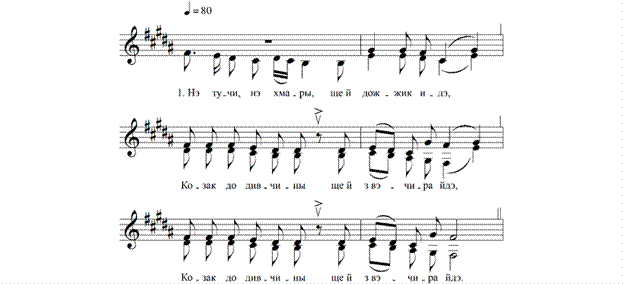
In the vast majority, the melodies of lyrical songs are coordinated with a syllabic (or caesurated) verse. The forms of caesurized versification are most characteristic of the tradition under study. A polyphonic organization is characterized by the presence of several types of texture in the tradition. The functional two-voice with eyeliner dominates, characteristic of most South Russian and Ukrainian folklore traditions. This type of texture is characterized by the autonomous realization of the lower voice part, the main part performed by the majority of the members of the singing ensemble, and the upper voice part, which in most cases is in perfect correlation with the reference sounds of the lower voice part. An alternative in the ratio of the lower and upper voice parts may be other consonant intervals – a fifth, an octave.: Example 1. Anastasivskaya St., Slavyansky district, KK (Field materials of the author's folklore and ethnographic expedition)
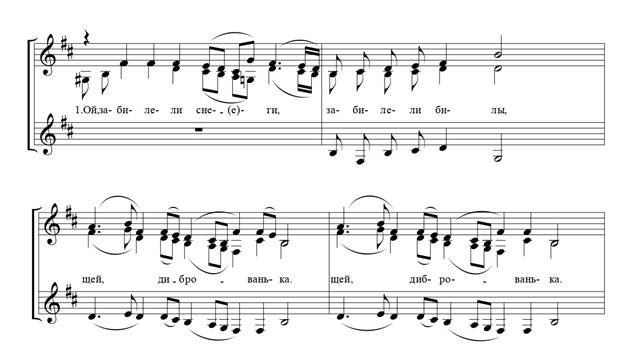
Under the condition of a heterophonic branching of the lower vocal part, "islands" of movement are formed in two-voice melodies: but you don't have chords here, look at the example, you need to replace Example 2. St. Staromyshastovskaya, Dinsky district, KK (Field materials of the author's folklore and ethnographic expedition)
In a number of song examples, you can see that the lower male voice (bass) performs not a fret, but a purely coloristic function, only doubling the main melody by an octave. Example 3. St. Anastasivskaya, Slavyansky district, KK (Field materials of the author's folklore and ethnographic expedition) 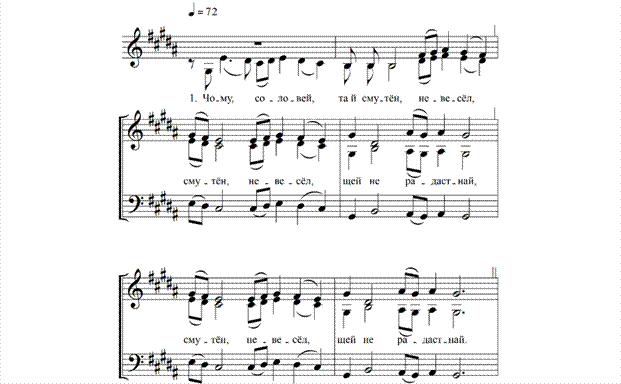
The fret organization of Black Sea lyrical songs manifests itself in the conditions of the realization of the melody mainly in wide-volume sound scales. Both horizontally and vertically-the fret oppositions actively manifest themselves in the frets of the Black Sea lyrical songs. Taking into account the Carriers of the fret functions, in most cases there are third consonances or triads that realize the vertical-fret opposition of two third rows of 1 and 2 steps 1/3/5 – (IV-II)-2/4/6 . In the context of the deployment of melodies in wide-volume scales exceeding octaves, the peculiarities of polyphonic organization (the tert line created by the upper voice part and periodic bass detachments), the complex of fret oppositions is realized extremely close to the frets of the harmonic type – major and minor. Thus, the fret supports in many tunes are 1, 2-4, 5, IV. The high–pitched organization of Black Sea lyrical songs, the origin of which for the most part correlates with the historical period of the XVIII - XIX century, and regionally with the territory of Ukraine, thus reflects the influence of European traditional thinking, in particular church party singing, under the influence of which a new style of folk singing culture has developed in the metropolitan tradition. It can be stated that not only this, but also another feature of the melodics of Ukrainian folk music texts has been preserved on the territory of the Kuban Black Sea region - a very moderate, and in many cases absent intrasyllabic chant (the so–called unsung lyrics). Although Black Sea lyrical songs have their own content and stylistic specifics (noted above), they share functional, structural and stylistic features common to the entire genre. The stabilizing factors are: the predominant types of polyphony (two-voice with eyeliner, cantonal three-voice), the harmonic type of fret connections, as well as the unified compositional principles of melodies. In general, the lyrical song of the Black Sea Cossacks of Kuban appears as a multilevel system of various rhythmic and high-pitched forms with its inherent performance features. The system-forming core here is the dominant ways of organizing both poetic and musical rhythm, as well as the most important sound-pitch levels.
The article is published in its final version as approved following the last positive peer review recommending acceptance for publication. It incorporates revisions made by the author in response to prior negative peer review reports that did not recommend publication. All peer review reports, including initial negative reviews, are published in open access alongside the article. All versions of the author’s revisions are archived in the publisher’s repository and may be made available upon reasonable request in accordance with Elsevier’s editorial policies and applicable data availability requirements.
Read all reviews on this article
References
1. Engovatova, M. A. (2010). Russian lyrical songs in the system of genres of musical folklore. In Proceedings of the Second Congress of Folklorists (Vol. 1, pp. 383-389). GRC RF.
2. Lopatkin, N. M., & Prokunin, V. P. (1956). Russian folk lyrical songs (V. M. Belyaev, Ed.). State Music Publishing House.
3. Bondar, N. I. (2002). Kuban Cossacks. In Essays on the traditional culture of the Cossacks of Russia (Vol. 1, pp. 236-245).
4. Bigdai, A. D. (1992). Songs of the Kuban Cossacks (Vol. 1, V. G. Zakarchenko, Ed.). Kniga Izdatel'stvo.
5. Kontsevich, G. M. (2001). Folk songs of the Cossacks. EDDI.
6. Zakarchenko, V. G. (1997). Folk songs of Kuban (Vol. 2). Soviet Kuban.
7. History, ethnography, folklore of Kuban (2024). (N. I. Bondar, Ed.; N. I. Bondar & V. V. Voronin, Comp.).
8. Rudichenko, T. S. (2004). The Don Cossack song in historical development. Rostov State Conservatory named after S. V. Rachmaninov.
9. History, ethnography, folklore of Kuban (2015). (I. I. Bondar & A. I. Zudin, Eds.; Comp.). Kniga.
10. History, ethnography, folklore of Kuban (2019). (N. I. Bondar & A. I. Zudin, Eds.; Comp.).
11. History, ethnography, folklore of Kuban (2025). (V. V. Voronin, Ed.; Comp.).
First Peer Review
Reviewer: Mikhailova Alevtina Anatol'evna, Doctor of Art History; Professor, Head of the Department of Folk Singing and Ethnomusicology, Saratov State Conservatory named after L.V. Sobinov
DOI:10.25136/review.36022
The subject of the study of the article "Lyrical songs of the Black Sea Cossacks of Kuban: features of functioning and poetic content" is the genre of lyrical song in the traditional musical culture of the Black Sea Cossacks of Kuban. The author examines the thematic diversity, plot-figurative structure, living conditions and gender differentiation of the lyrical repertoire (male military and female "stanitsa" lyrics). The empirical base consists of both published collections (A.D. Bigdai, G.M. Kontsevich, V.G. Zakharchenko, the multi-volume edition "History, Ethnography, Folklore of Kuban") and the author's own field notes made in the villages of Staromyshastovskaya (2014), Anastasievskaya (2024) and Leningradskaya (2024). The methodology has a complex ethnomusicological and folkloristic character. The work uses the historical and genetic method to analyze the formation of the Kuban folklore tradition as a result of the interaction of Eastern Ukrainian and Southern Russian (Don) cultures; the comparative and typological method to identify thematic groups within male and female lyrical cycles; the structural and semiotic method to analyze poetic lyrics (motifs of fate, separation, death, love, widowhood); field ethnography – the author relies on his own audio and video recordings, which increases the reliability of conclusions about the current state of the tradition. This approach allows us to consider a lyrical song not in isolation, but in the context of the social structure, gender roles and worldview of the Black Sea Cossacks. The relevance of the article is determined by the fact that the Kuban folklore tradition, despite its brightness and preservation (thanks to the activities of the Kuban Cossack Choir and the scientific research Center of Traditional culture), remains insufficiently studied at the level of academic genre analysis; lyrical song as an "absorbing" genre reflects the processes of cultural interaction and adaptation in the region of late formation, which allows to trace the mechanisms of tradition transformation; in the context of the revival of Cossack identity in modern Russia, a scientifically verified description of the song heritage has not only academic, but also practical significance for the activities of folklore groups and cultural institutions. The scientific novelty of the article lies in the following provisions: For the first time, a detailed thematic classification of lyrical songs of the Black Sea Cossacks of the Kuban is proposed, divided into male (military) and female ("stanichny") cycles. There are thematic groups within the men's cycle: about fate / fate, about the hardships of service, about death in a foreign land, about separation from relatives and loved ones. Inside the female – about an unhappy fate / unsuccessful marriage, about betrayal, about separation, about widowhood. New field materials have been put into scientific use (recordings from 2024 from the villages of Anastasievskaya and Leningradskaya), including songs of local origin. The conventionality of the gender division of lyrical songs in modern performance practice has been identified and substantiated – despite the differences in subject matter, songs are performed by mixed ensembles, and military songs are more often recorded by women today. The role of the lyrical genre as a "core" in the culture of the Black Sea Cossacks is proved, reflecting not only everyday realities, but also existential experiences (fate, death, homesickness). The article is written in clear academic language, but with the preservation of a lively "field" breath when quoting song lyrics. The structure is logical and consistent: an introduction substantiating the importance of the lyrical genre and a review of literature; the historical and ethnographic context of the formation of the Kuban tradition; characteristics of the source base and living conditions; the main analytical block: division into male and female cycles with thematic groups and extensive quotations; conclusion on the intertwining cycles and the conditionality of their separation. The most significant strengths are: a high–quality selection of song examples – each thesis is confirmed by a detailed quotation (sometimes in the Ukrainian dialect while preserving phonetic features); analysis of local specifics - the song "Oh, you jackdaws, jackdaws, jackdaws" from St. Anastasievska with its unique dialogical plot and the motif "pan does not let in"; fixation of changes In performing practices, there is a transition from male to female performance of military songs at the present stage. The bibliographic list (11 sources) is representative, but small in volume. The key collections of Kuban folk songs (Bigdai, Kontsevich, Zakharchenko), the fundamental multi-volume edition "History, Ethnography, folklore of Kuban" (volumes I, IV, VI, VII), as well as theoretical works on the lyric song (M.A. Engovatova) and the Don Cossack song (T.S. Rudichenko), which is used by as a methodological guideline. The appeal to the opponents is weak. The author mentions a discussion about the division of lyrics into "old" and "new–fangled" songs (Lopatin - Prokunin), but does not develop this controversy in relation to the Kuban material. There is no polemic with potential critics (for example, with those who consider the gender division to be artificial or imposed by the researcher). There is no dialogue with the possible objection that the songs cited may not be "Black Sea", but all-Ukrainian or all-Russian, brought in by immigrants. The author accepts tradition as a given, without problematizing the issue of authenticity and the degree of local specificity. A stronger appeal can be considered an implicit appeal to T.S. Rudichenko (the author of the monograph on the Don Cossack song), whose methodology of dividing into male and female cycles is accepted and adapted to the Kuban material – this is a reference to an authoritative predecessor, but not a polemic with him. Possible disadvantages and recommendations: 1. There is an imbalance between philological and musicological analysis in the text of the work. The stated scientific field is art history and cultural studies, however, the article practically lacks musical analysis (melody, harmony, rhythmic structures, types of intonation, the connection of words and melodies). Recommendation: change the genre self-identification of the article in favor of "philology and folklore studies" or add music analytics for the art history journal. 2. Lack of comparative context. The author does not compare the lyrics of the Black Sea Cossacks with the lyrics of other Cossack troops (Don, Tersk, Ural, Siberian), nor with the Ukrainian urban and peasant lyrics of the XVII–XIX centuries. This makes it impossible to conclude what is specifically "Black Sea" and what is common Cossack or common Slavic. Recommendation: Add a 1-2-page comparative section. 3. The problem of field record representativeness. The author indicates three expeditions (2014, 2024, 2024), but does not say how many informants were interviewed, what is their age, what is the degree of preservation of tradition in each village. Without these data, it is difficult to assess the representativeness of the conclusions. Recommendation: Include a brief description of the informants and recording techniques. 4. Lack of musical notation. Despite the fact that the article was published in the musicological journal (Philharmonica. International Music Journal), the lack of musical examples is a serious disadvantage. The reader cannot appreciate the musical specifics of these songs. Recommendation: provide the article with musical transcriptions of at least 2-3 key samples. 5. Stylistic and technical shortcomings: – The quoted song lyrics use non-standard phonetic notation ("break through", "viyut", "turnitsia", "pizdno", "odivonka", etc.), but there is no explanation.: is this an author's field transcription or a dialect norm? A brief information about the phonetic features of the Black Sea speech is desirable. – There are repetitions in the text (for example, "at the moment, even military songs are recorded mainly in female performance" – this thought is carried out twice). - The date of access to the sources is not indicated for most archival materials (although they are not listed, but the references in the text to field records are dated 2014 and 2024). There are no references to modern dissertation research on Kuban folklore (for example, the works of A.S. Kabanov, T.V. Digun, mentioned in the introduction, but not included to the list).
6. Insufficient problematization. The author does not raise questions about the boundaries of the genre (what is considered a lyrical song, and what is a ballad or a historical song?), about the methodological difficulties of distinguishing the "Ukrainian" and "Russian" layers in the Black Sea tradition, about the influence of literary poetry (cantos, romances) on folklore. The article would be deeper if it included at least one discussion line. In general, the article is a good descriptive study, introducing new field materials into scientific circulation and offering a well-founded thematic classification of lyrical songs of the Black Sea Cossacks of the Kuban. The author successfully demonstrates the genre richness and emotive depth of Cossack lyrics, reveals the gender differentiation of the subject matter and at the same time shows the conventionality of this division in modern performing practice. The work is of undoubted value for ethnomusicology, folklore studies and cultural studies of the Cossacks. However, the article tends to philological (subject-thematic) analysis to the detriment of musical and stylistic analysis, which narrows its genre to the "poetics of song lyrics" without a full-fledged musicological dimension. The article has an undoubted value as a source-based and thematic-classification study of Kuban Cossack lyrics. It can be recommended for publication after significant refinement, including: the addition of a musical and stylistic section with musical examples; the introduction of a comparative context with other Cossack traditions; clarification of field methodology; elimination of stylistic errors. In its current form, the article will be useful primarily for folklore philologists and entry-level ethnomusicologists, but a leading specialized journal on art history requires deeper analysis and interdisciplinarity.
Second Peer Review
Reviewer: Osipov Sergey Viktorovich, PhD in History; Associate Professor; Department of History and Culture; Ulyanovsk State Technical University
DOI:10.25136/review.36551
The reviewed text "Lyrical songs of the Black Sea Cossacks of Kuban: features of functioning and musical and poetic stylistics" is a comprehensive study of the corpus of songs related to the Kuban Cossack folklore tradition; a comprehensive analysis of the songs under consideration allows the author to formulate ethnographic, musicological and even, in some way, socio-historical narratives. The direct object of the study is the songs recorded by the author during field ethnographic expeditions in three villages of the Kuban (Krasnodar Territory), which in itself is already an innovation of the peer-reviewed study. The analysis of the songs is preceded by a theoretical justification for understanding the lyrical musical tradition in general and Kuban folklore in particular; the author characterizes in sufficient detail the source of the analyzed material, i.e. the folklore collective of a particular village. It is somewhat unclear how the author's field recordings relate to other categories of sources used, i.e. the author points out that "the source base of the study includes the author's field recordings made in the Black Sea villages of Staromyshastovskaya (2014), Anastasievskaya (2024) and Leningradskaya (2024), as well as published samples of Kuban lyrical songwriting in collections by A.D. Bigdai [4], G.M. Kontsevich [5], V.G. Zakharchenko [6], as well as the multi-volume edition "History, Ethnography, Folklore of Kuban" based on the folklore and ethnographic fund of the scientific Research Center for Traditional Culture of the Kuban Cossack Choir. At the same time, it is not indicated how the songs identified in the course of field research relate to the already well-known body of Kuban musical folklore, whether there are specifics, etc. Based on the above set of sources, it is assumed that the author worked with a significant body of song folklore; in the direct study, only eight examples are mentioned, and mainly from field research materials; therefore, in principle, the question of the representativeness of the analyzed songs can be raised for general conclusions about the lyrical songs of the Black Sea Cossacks of the Kuban as a whole. In direct research, the author proceeds from the division of lyrical song folklore into two thematic blocks: "male, military (in folk terminology — Cossack) songs… and the songs of rural life, conventionally female." If, in relation to men's songs, the author clearly identifies four thematic (plot) groups and illustrates each with a specific example, then women's songs are not analyzed in a similar way, here the author simply restricts himself to examples. The complexity of the analysis consists in a consistent consideration of the subject matter and typical plots, high-pitch specifics, and the ethnographic environment of origin. In general, the author copes with the set range of tasks, the above remarks are not of a fundamental nature. The work can be recommended for publication.
|

 Eng






 © 1998 – 2026 Nota Bene. Publishing Technologies. NB-Media Ltd.